
Ecosia vs. DuckDuckGo: Privacy or Planet?

Breaking free from Big Tech’s surveillance machinery is no longer just for paranoid hackers. Millions are abandoning Google to reclaim their autonomy, yet the exit strategy often halts at a crossroads.
Two distinct challengers dominate this space. Ecosia appeals to the eco-conscious user by promising to heal the planet with every search.
DuckDuckGo caters to the security purist by ensuring no personal data ever leaves the browser.
While both options outperform the mainstream giants, they offer fundamentally different values. The final decision rests on a specific priority.
You must determine if you want your online activity to generate physical impact through reforestation or if you prefer the peace of mind that comes with total data invisibility. This is not just about changing a default setting; it is about choosing between saving the earth and shielding your identity.
Key Takeaways
- Core Philosophy: Ecosia is a social business dedicated to global reforestation, while DuckDuckGo is a privacy-first company focused on digital civil liberties.
- Privacy Levels: DuckDuckGo uses a strict zero-knowledge policy with no data storage. Ecosia offers “friendly privacy,” anonymizing search data after seven days.
- Revenue Model: Both platforms reject behavioral tracking, instead using contextual ads based on current search terms to generate revenue.
- Search Results: Ecosia utilizes a hybrid of Bing and Google results. DuckDuckGo relies primarily on Bing and integrates Apple Maps for location searches.
- Transparency: Ecosia publishes monthly financial reports to prove its environmental impact. DuckDuckGo uses open-source code to demonstrate its security protocols.
Core Mission and Social Impact
Every tech company claims to value its users, but Ecosia and DuckDuckGo back these claims with fundamentally different operational philosophies. One prioritizes the physical restoration of the environment, while the other focuses on the digital preservation of civil liberties.
These distinct missions shape every feature they build and every dollar they spend.
Ecosia: The Reforestation Engine
Ecosia operates as a social business where financial success directly translates to environmental rehabilitation. Their model is straightforward.
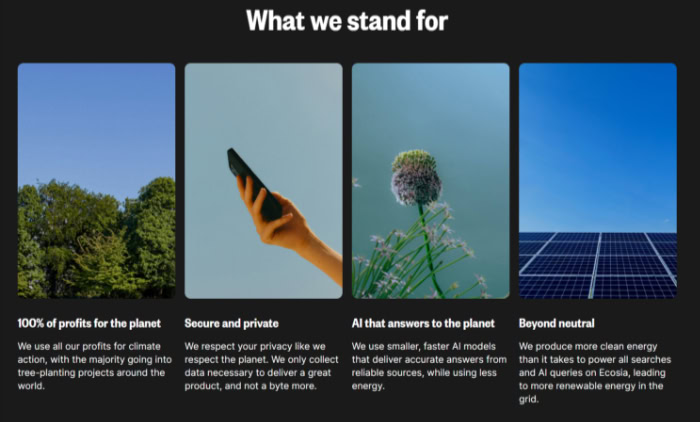
They dedicate 100% of their profits to climate action, with roughly 80% specifically allocated to tree-planting projects across the globe. This is not a side project; it is the primary reason the search engine exists.
To prove they are not simply marketing themselves as green, Ecosia publishes monthly financial reports. These documents detail exactly how much money came in from ad revenue and exactly where it went, down to the specific tree-planting organizations they fund.
They focus on biodiversity hotspots to ensure they are restoring ecosystems rather than just planting monocultures. For the user, this mission is visualized through a gamified “Levels and Seeds” system.
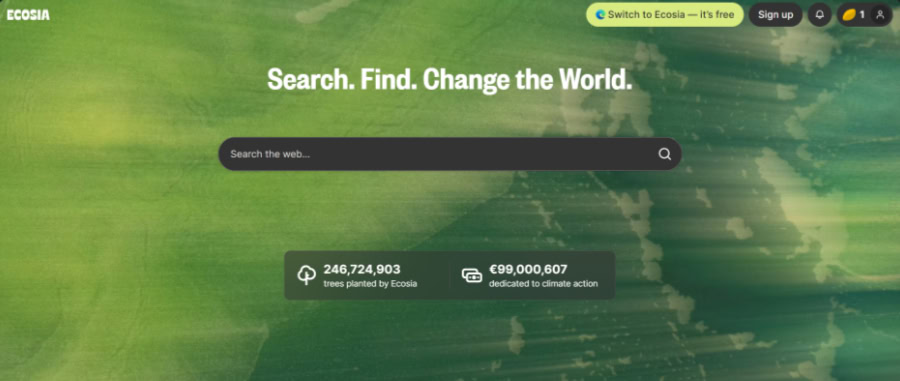
Instead of a simple search counter, users now earn growth points and collect seeds to unlock detailed impact statistics. The interface displays tangible metrics, such as “Area Restored” and “Hours of Tree Care,” creating a satisfying feedback loop that turns a mundane daily task into a visible contribution to the planet.
DuckDuckGo: The Privacy Crusaders
DuckDuckGo views privacy as a fundamental human right that has been eroded by modern tech giants. Their goal is to make digital safety simple and accessible for everyone, not just those with technical expertise.
They argue that privacy should be the default setting, not a complex configuration hidden deep in a menu.
Beyond their product, DuckDuckGo acts as an active advocate for internet rights. They donate significantly to organizations that fight for digital freedom and conduct research to expose how trackers follow users across the web.
Their philosophy centers on “Privacy by Design.” This means they build their systems from the ground up to prevent data collection, rather than collecting data and promising to protect it later.
They aim to prove that a profitable tech company does not need to harvest personal information to survive.
Privacy Standards and Data Handling

Security and data protection serve as the main selling points for alternative search engines, yet the implementation varies significantly between the two. While both platforms offer a massive improvement over standard tracking-heavy options, they handle user data and legal obligations in distinct ways.
Data Collection Policies
DuckDuckGo adheres to a strict “zero-knowledge” policy. They do not log IP addresses, they do not store search history, and they do not create user profiles.
When a search occurs, the engine processes the request and immediately forgets who sent it. There is no incognito mode because the entire platform effectively functions as one.
Ecosia takes a slightly different approach known as “friendly privacy.” They value user anonymity but balance it with the need to optimize their service.
Ecosia retains temporary search data (such as IP addresses) to prevent fraud and analyze performance. However, they anonymize or delete this data after seven days and explicitly do not build personal profiles.
They do not sell this data to third-party advertisers, and they do not build permanent profiles based on search behavior.
Tracker Blocking and Security
DuckDuckGo extends its protection beyond the search bar. Their browser extensions and mobile apps include a feature called “Global Privacy Control,” which signals to websites that the user does not wish to be tracked.
They also offer app tracking protection on mobile devices, blocking hidden third-party trackers in other apps.
Ecosia protects users by encrypting all searches, ensuring internet service providers cannot see specific queries. Unlike standard websites, they avoid using external trackers like Google Analytics by default.
However, because they rely on partners like Microsoft Bing and Google to provide results, search terms and IP addresses are shared with these providers to answer queries. Advanced analytics tools, such as Microsoft Clarity, are only activated if the user explicitly consents.
The Jurisdiction Factor
Physical location plays a major role in data privacy due to local laws. Ecosia is based in Germany, meaning it operates under the General Data Protection Regulation (GDPR).
This is widely considered one of the strictest privacy frameworks in the world, offering users robust legal protection against data misuse.
DuckDuckGo is headquartered in the United States. While they maintain strict internal policies against data collection, they operate within a legal jurisdiction known for surveillance programs like the Patriot Act.
Because DuckDuckGo does not store user data to begin with, they technically have nothing to hand over if served with a warrant. However, for users who are wary of US intelligence reach, the difference in jurisdiction remains a relevant consideration.
Search Quality and Backend Technology

A search engine is only useful if it finds what the user is looking for. Since building a completely new index of the entire internet is prohibitively expensive, most alternative search engines rely on existing infrastructure to power their results.
Both Ecosia and DuckDuckGo lean heavily on partnerships to deliver answers.
The Search Partner Connection
Neither Ecosia nor DuckDuckGo manages their own independent web index. DuckDuckGo primarily utilizes Microsoft Bing’s technology to source its results.
Ecosia, however, has shifted to a hybrid model. Depending on the user’s region and settings, Ecosia now delivers results from either Microsoft Bing or Google.
This partnership ensures that users have access to massive, up-to-date libraries of web pages without the alternative companies needing to build their own server farms.
Local Search and Maps
Mapping remains one area where the two diverge significantly due to their integration choices. DuckDuckGo uses Apple Maps to power its location-based searches.
This integration provides a high-quality interface and accurate directions while adhering to strict privacy standards. It allows users to find a nearby coffee shop without their location history being logged.
Ecosia utilizes a mix of Google Maps and Bing Maps depending on the user’s region and device. While this ensures high accuracy and familiarity for users switching from Google, it involves interacting with the mapping APIs of larger data companies.
However, Ecosia acts as a proxy, meaning they do not pass the user’s personal tracking data to these mapping providers during the search.
Image and Video Search Capabilities
When searching for visual media, the user interface plays a large role in the experience. DuckDuckGo offers a streamlined image search that acts as a privacy shield.
Instead of loading an image directly from a source website (which would reveal your IP address to that site), DuckDuckGo proxies the image through their own servers first. Their video search similarly allows users to play content directly on the page without navigating to the host site, preventing unwanted tracking.
Ecosia presents a clean, grid-based layout for images that mirrors the simplicity of major competitors. Their filters are effective, though sometimes less granular than those found on DuckDuckGo.
The video tab functions similarly, pulling results primarily from Bing’s video index. The focus here remains on delivering a visual experience that feels familiar to anyone coming from a mainstream search engine, reducing the friction of switching.
User Interface and Productivity Features
While the backend technology powers the results, the user interface determines how efficient the daily search experience feels. DuckDuckGo creates a workspace optimized for speed and power users who want to minimize clicks.
Ecosia prioritizes a visual reminder of the user’s positive impact, creating an environment that feels softer and more mission-oriented.
DuckDuckGo’s Power Tools
DuckDuckGo distinguishes itself with features designed to accelerate web navigation. The most popular of these is the “!Bang” system.
This command-line-style feature allows users to search other websites directly from the DuckDuckGo search bar. For example, typing “!w” followed by a search term immediately redirects the user to Wikipedia.
However, users should note that using a “!Bang” takes you off DuckDuckGo’s platform. Once you land on the destination site (like Amazon or Wikipedia), that site’s tracking policies take over.
Beyond shortcuts, the platform offers “Instant Answers.” These are dynamic snippets that appear at the top of the results page to provide immediate information without requiring a click.
This is particularly useful for developers or students, as it can generate code snippets, color codes, loan calculations, or stopwatch functions instantly. It transforms the search engine into a functional utility tool rather than just a directory of links.
Ecosia’s Visual Experience
Ecosia designs its interface to reinforce its environmental mission without overwhelming the user. The platform recently evolved beyond a simple counter into a robust “Impact Profile.”
Users now progress through levels and collect seeds to track specific achievements, such as the amount of renewable energy generated. Additionally, Ecosia has integrated “Ecosia Chat,” a green AI assistant that provides direct answers and summaries to complex queries while utilizing energy-efficient models.
The settings menu on Ecosia leans toward simplicity rather than granular customization. Users can easily toggle Dark Mode, adjust Safe Search filters, or change search regions, but the options are streamlined to prevent confusion.
The overall aesthetic is clean and modern, often featuring photography of nature or reforestation projects as background wallpapers to keep the core mission visible.
Cross-Platform Availability
Both engines have worked hard to ensure they are accessible on every major device. DuckDuckGo and Ecosia offer dedicated mobile browsers for iOS and Android, as well as lightweight extensions for Chrome, Firefox, and Safari.
Major mobile operating systems have also recognized their importance; users setting up a new iPhone or Android device can now select either Ecosia or DuckDuckGo as their default search engine in the system settings, eliminating the need to download extra software to escape the Google ecosystem.
The Advertising Model and Transparency
The biggest question for any free service is how it generates revenue. Both Ecosia and DuckDuckGo rely on advertising to survive, but they fundamentally change the relationship between the advertiser and the user.
Unlike mainstream competitors that build complex profiles to predict what you might want to buy, these alternatives use a much simpler, less invasive model.
Contextual vs. Behavioral Ads
Both platforms utilize contextual advertising rather than behavioral advertising. This means the ads shown are based strictly on the search terms currently typed into the box, not on the user’s past history.
If a user searches for “running shoes,” the engine shows an ad for sneakers. If that user searches for “gardening tips” five minutes later, the sneaker ads disappear.
This approach eliminates retargeting. Users will not see an ad for a product they viewed yesterday following them around the internet today.
The ad network knows what the user is looking for in that exact moment, but it does not know who the user is, where they live, or what they have searched for previously.
Financial Accountability
Ecosia operates with radical financial transparency to prove its commitment to reforestation. They publish monthly financial reports available to the public.
These documents break down their total income, operational costs, marketing spend, and the exact amount funnelled into tree-planting projects. They also provide receipts and evidence from their partners on the ground, allowing anyone to audit their impact.
DuckDuckGo is a private company backed by venture capital and operates with a standard profit motive. While they are profitable and sustainable, they do not release public financial audits.
Their accountability comes in the form of privacy audits and open-source contributions rather than financial disclosures. Users trust DuckDuckGo to protect their data, while users trust Ecosia to spend their money responsibly.
Detecting “Greenwashing” vs. “Privacy-washing”
Skepticism is healthy when companies claim to save the world or protect civil liberties. To combat accusations of “greenwashing,” Ecosia secured B Corp certification, a rigorous standard for social and environmental performance.
They also use satellite monitoring and field visits to ensure the trees they fund are actually surviving and not just being planted and abandoned.
DuckDuckGo combats “privacy-washing” by making much of their code open source. This allows independent security researchers to examine how the browser extension and app actually work.
By allowing the community to inspect their tools, they provide technical proof that their blocking mechanisms function as advertised and that they are not secretly hoarding data behind the scenes.
Conclusion
Selecting between Ecosia and DuckDuckGo requires choosing a specific type of impact. Ecosia offers a balanced approach that actively improves the physical environment, while DuckDuckGo provides a fortified experience focused solely on data protection.
Both remove the invasive tracking found in mainstream options, but they replace it with different benefits.
For the environmentally conscious user, Ecosia serves as the logical option. It allows individuals to contribute to climate action simply by browsing the web, turning a passive habit into a quantifiable good.
For the security specialist, DuckDuckGo stands out as the superior tool. Its strict data shielding and efficiency features like !bangs cater to those who demand absolute control over their information.
Ultimately, both platforms represent a significant upgrade for personal liberty. The decision rests on which value takes precedence in your daily life.
If the goal is to restore the planet, Ecosia is the answer. If the priority is to vanish from the data grid, DuckDuckGo is the solution.
Frequently Asked Questions
Is Ecosia legit and do they really plant trees?
Yes, Ecosia is a legitimate certified B Corp. To maintain trust, they publish monthly financial reports that are available to the public. These documents detail exactly how much revenue they generate and proof that 100% of their profits go toward climate action. They work with local partners to plant native tree species in biodiversity hotspots rather than industrial monocultures.
Is DuckDuckGo owned by Google or Microsoft?
No, DuckDuckGo is an independent company based in the United States. They are not owned by Google, Microsoft, or any other technology conglomerate. While they partner with Microsoft to access the Bing search index for results, they remain a completely separate legal entity with their own strict privacy policies.
Which search engine offers better privacy protection?
DuckDuckGo offers superior protection for users who want maximum security. It operates on a zero-knowledge policy, meaning it never logs IP addresses or search history to disk. Ecosia is far more private than Google, but it does temporarily retain anonymized data for up to seven days to help analyze system performance before deleting it.
Do Ecosia and DuckDuckGo show the same search results?
Not necessarily. DuckDuckGo sources its results primarily from Microsoft Bing. Ecosia, however, now uses a hybrid model that may serve results from Google or Bing depending on your region. Therefore, you might see different websites and rankings on Ecosia compared to DuckDuckGo.
How do these companies make money if they don’t sell data?
Both platforms generate revenue through contextual advertising. This implies that ads are served based strictly on the search term you just typed, rather than your personal history. If you search for “camping gear,” they show an ad for a tent. They do not build a profile of your interests or sell your behavior patterns to third-party marketers.
About the Author: Julio Caesar


