
Is a Projector Worth It? Before You Buy

The dream of a dedicated home theater often collides with a harsh financial reality. Once you look beyond a standard 75-inch panel, television prices climb vertically.
This creates a natural opening for the projector, offering a screen size that dwarfs a TV for a fraction of the cost. Modern projection hardware has quietly evolved from blurry classroom tools into sophisticated home entertainment hubs featuring 4K resolution and smart streaming capabilities.
Yet the decision is rarely straightforward. Swapping a TV for a projector is not just a hardware change; it is a lifestyle commitment.
The final verdict relies entirely on your specific room conditions, your tolerance for setup logistics, and exactly how much you value cinematic immersion over ease of use. Before you dim the lights, you must weigh the substantial benefits against the practical limitations of projection technology.
The Economics of Immersion
The primary motivation for choosing a projector almost always comes down to simple math. Consumers want the largest possible image for the lowest possible price.
While television panels have grown consistently larger over the last decade, they eventually hit a financial barrier that makes them impractical for the average buyer. Projectors bypass this limitation entirely.
They offer a cost-effective route to a viewing experience that dominates the room.
The Price Barrier at 85 Inches
Television pricing follows a predictable curve until the screen size reaches about 85 inches. Beyond this point, the cost per inch skyrockets exponentially.
A 98-inch or 100-inch television is often considered a luxury item, with prices that can rival the cost of a decent used car. In contrast, a mid-range projector can easily cast a 120-inch or even 150-inch image without any significant increase in cost.
The price remains relatively stable regardless of the image size, as the limitation is usually the wall space rather than the hardware itself.
There is also a physiological difference in how we perceive these massive images. Televisions emit light directly into your eyes, which can cause fatigue during long viewing sessions, especially in a dark room.
Projectors rely on reflected light, bouncing the image off a screen before it reaches the viewer. This creates a softer, more natural look that mimics the experience of a commercial movie theater.
For many enthusiasts, this reflected light is the defining characteristic that separates “watching TV” from “cinema.”
Analyzing Budget Tiers
Finding the right projector requires identifying the sweet spot between performance and cost. The market generally splits into three distinct categories.
- Entry-Level: These are often portable 1080p units. They are inexpensive and great for casual movie nights, but they often lack the brightness and sharpness required for a permanent home theater setup.
- Mid-Range: This is where the best value exists for most homeowners. These projectors typically use “pixel shifting” technology to achieve a 4K image. They offer excellent sharpness and color reproduction at a price point comparable to a standard 65-inch premium TV.
- High-End: The top tier consists of native 4K laser projectors. These units provide the crispest possible image and superior contrast, yet the price jump is significant. For the average viewer, the diminishing returns here are real. The mid-range tier usually offers 90% of the performance for half the price.
The “Dark Room” Requirement
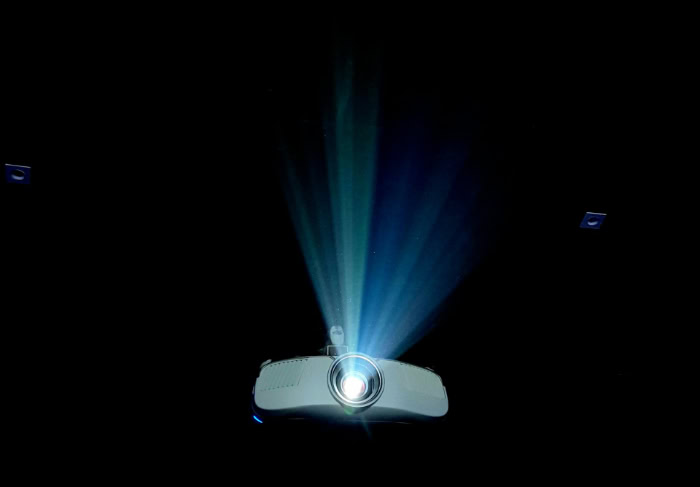
Before purchasing a projector, you must honestly assess the room where it will live. Unlike televisions, which can fight through glare with sheer brightness, projectors are passive devices that rely heavily on the environment.
A high-quality projector placed in a poor environment will look worse than a cheap TV. The feasibility of a projection setup is dictated almost entirely by your ability to control light.
The Impact of Ambient Light
The fundamental physics of projection creates a unique challenge. A projector cannot create black; it can only project light.
The “black” parts of an image are simply the absence of light on the screen. If your room has ambient light, sunlight streaming through windows or lamps turned on, that light hits the screen and turns those dark areas gray.
This washes out the image and destroys contrast.
This distinction separates a dedicated home theater from a multi-use living room. In a dedicated “batcave” with blackout curtains and dark paint, a projector shines.
In a typical family room with white walls and uncontrolled daylight, the image will struggle. If you plan to watch sports on a Sunday afternoon with the blinds open, a projector is likely the wrong tool for the job.
Lumens and Screen Selection
To combat ambient light, you need brightness, which is measured in lumens. A dark theater room might only need 1,500 to 2,000 lumens for a stunning picture.
However, a living room with some ambient light often requires 3,000 lumens or more to maintain a watchable image.
One solution for imperfect rooms is an Ambient Light Rejecting (ALR) screen. These specialized screens have a jagged optical structure that reflects light coming from the projector towards the viewer while bouncing ambient light from the ceiling or windows away.
While effective, ALR screens are expensive. They can sometimes cost as much as the projector itself, adding a significant hidden cost to the setup that buyers must anticipate.
Image Quality Reality Check

While projectors win on size, modern televisions generally hold the advantage in pure picture fidelity. Technologies like OLED and QLED have set a remarkably high bar for resolution, contrast, and dynamic range.
A projector buyer must be willing to trade absolute precision for the immersion of a massive screen.
Contrast and Black Levels
The biggest struggle for any projector is achieving deep, inky blacks. Because a projector is blasting light onto a screen, and because even a dark room has some light reflections, the “black” on a projector screen is usually a very dark gray.
OLED televisions, by comparison, can turn off individual pixels to achieve perfect black and infinite contrast. For cinephiles who prioritize shadow detail and dynamic range over sheer size, this performance gap is noticeable.
You are trading the perfection of the image for the scale of the experience.
Resolution and HDR Limitations
Marketing terminology can be confusing in the projector space. Many “4K” projectors are not Native 4K.
Instead, they use a technology called pixel shifting, where a lower-resolution chip flashes multiple times per frame at high speeds to simulate a 4K image. The result is surprisingly good and indistinguishable from native 4K at normal viewing distances, but it is technically a workaround.
High Dynamic Range (HDR) is another area where projectors lag behind TVs. HDR relies on the ability to display extremely bright highlights alongside dark shadows.
Televisions can achieve peak brightness levels that projectors simply cannot match. While projectors can process HDR signals, the visual impact is less dramatic than what you would see on a high-end flat panel.
Color Accuracy and Light Sources
Color performance depends largely on the light source. Traditional lamp-based projectors can have good color but dim over time.
LED and Laser models offer wider color gamuts and maintain their saturation levels for thousands of hours. Laser projectors, in particular, produce incredibly rich and accurate colors that can rival televisions, but this technology commands a premium price.
The choice of light source defines not just the image quality, but also the maintenance requirements and lifespan of the device.
The Ecosystem of Hidden Costs and Setup

The sticker price of a projector is rarely the final cost. Unlike a television, which serves as a self-contained entertainment unit, a projector is merely one component in a larger system.
Achieving a functional home theater experience requires additional hardware and accessories that can significantly inflate the total budget. Buyers must look beyond the box to understand the full scope of the investment required to get a picture on the wall.
The Audio Necessity
Most televisions come with serviceable speakers that allow for immediate plug-and-play use. Projectors are different.
While many units include built-in speakers, the audio quality is notoriously poor. The sound is often tinny, lacks bass, and emanates from the projector itself, which is usually positioned behind or above the viewer rather than near the screen.
This disconnect between where the image is and where the sound comes from breaks immersion instantly.
Consequently, external audio is effectively mandatory. At a minimum, this means purchasing a soundbar.
For a true theater experience, a receiver and surround sound speakers are necessary. This adds cost not only for the equipment but also for the cabling and setup time required to route audio from the source to the speakers.
Screen vs. Wall
A common misconception is that a white wall serves as a perfectly adequate screen. In reality, drywall has texture, bumps, and imperfections that become glaringly obvious when illuminated by a bright light source.
Standard interior paint also absorbs light rather than reflecting it back to the viewer, resulting in a dull and muddy image. To get the performance you paid for, you need a dedicated screen.
Screens vary wildly in price and function. A fixed-frame screen offers the best surface tension and picture quality but requires dedicated wall space.
Motorized or pull-down screens can retract when not in use, preserving the room's aesthetic, but they are prone to curling at the edges over time. High-end motorized tensioned screens solve this but can cost as much as the projector itself.
This expense is a necessary part of the equation that many first-time buyers overlook.
Installation Logistics
Setting up a television involves placing it on a stand or screwing a bracket into studs. Projectors demand more complex geometry.
You must calculate the “throw distance,” which is the specific distance the lens must be from the screen to produce the desired image size. Long-throw projectors typically mount on the ceiling, requiring a sturdy mount and a plan for hiding long HDMI and power cables that run across the room.
Ultra Short Throw (UST) projectors sit on a cabinet inches from the wall, which simplifies cabling but introduces its own challenges. Because the angle of projection is so steep, even a fraction of an inch of misalignment results in a distorted image.
Furthermore, projectors generate significant heat and rely on fans for cooling. In a small room, the whir of a cooling fan during quiet movie scenes can be a distraction that you never encounter with a silent TV.
Gaming, Portability, and Aesthetics
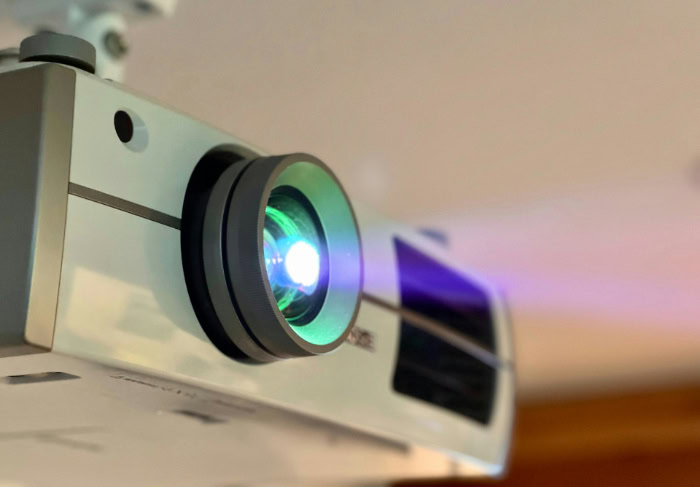
Beyond the technical specifications and costs, owning a projector changes how you interact with your living space. There are unique advantages to projection technology that televisions simply cannot replicate.
These factors often appeal to specific lifestyle needs, from hardcore gaming to interior design flexibility, offering benefits that go beyond simple picture quality.
Gaming on a Projector
For years, gamers avoided projectors due to terrible input lag and slow response times. That era is over.
Modern gaming projectors are built with low-latency modes that rival dedicated gaming monitors, supporting high refresh rates of 120Hz or even 240Hz. This makes them viable for fast-paced shooters and competitive play where reaction time is critical.
The real draw for gamers, however, is the sheer scale of local multiplayer. Split-screen gaming on a television often leaves each player squinting at a tiny quadrant of the screen.
On a 120-inch projector display, a four-player split-screen gives each person a viewable area comparable to a standard 60-inch TV. It revitalizes the couch co-op experience, making it immersive and social in a way that standard panels cannot match.
Portability and Versatility
One of the most distinct advantages of a projector is its mobility. A 75-inch TV is a permanent fixture; moving it requires two people and a risk of injury or breakage.
A projector, however, can be tossed in a backpack. This allows for “pop-up cinema” experiences that are impossible with a TV.
You can take the device to the backyard for an outdoor movie night, bring it camping, or simply move it from the living room to the bedroom for a change of scenery.
Portable “pico” projectors take this a step further. While they sacrifice brightness and resolution, these battery-powered units allow travelers to project a movie onto a hotel wall or the side of a tent.
For users who prioritize flexibility and experiences over a permanent installation, this versatility is a massive selling point.
Interior Design and Aesthetics
Large televisions are essentially black mirrors. When turned off, they act as a giant, dark void that dominates the room and dictates the furniture layout.
Projectors offer a solution for the design-conscious homeowner who wants a big screen without the visual clutter.
With a retractable screen, the technology disappears completely when not in use, allowing you to reclaim your wall for art or shelving. Even with a fixed screen, the absence of a glossy, reflective glass panel makes the room feel warmer and less centered around technology.
Ultra Short Throw projectors are particularly popular in this regard, as they sit on a media console like a piece of high-end audio equipment, blending seamlessly into the decor rather than demanding attention as a focal point.
Conclusion
The choice between a projector and a television is ultimately a negotiation between immersion and convenience. Projectors offer a cinematic scale that no flat panel can touch at a reasonable price point.
They bring the magic of the movie theater into the home. However, that magic comes with conditions.
You must be willing to manage lighting, install separate sound systems, and accept that black levels might never reach the inky depths of an OLED panel. Televisions remain the champions of contrast and simplicity.
They work in any light and require zero setup beyond plugging them in.
To simplify the decision, you should weigh your specific habits against the limitations of each technology.
- Buy a Projector If: You refuse to settle for anything less than a 100-inch screen. You have a dedicated space where you can control sunlight with blackout curtains. You view movie nights or big sporting events as special occasions rather than background noise. You value portability and want the option to move your “screen” to the backyard or a different room.
- Stick to a TV If: You do most of your viewing during the day with the windows open. You demand the deepest blacks, sharpest 4K resolution, and blindingly bright HDR highlights. You want a streamlined setup that requires nothing more than a single power cable and a remote.
About the Author: Julio Caesar


