
Why Does Christopher Nolan Use IMAX? Explained

Christopher Nolan is arguably the most famous champion of the IMAX format in modern cinema. His obsession began when he became the first director to shoot sequences of a major Hollywood feature film using IMAX cameras for The Dark Knight in 2008.
By the time he released his historical epic The Odyssey in July 2026, he achieved a major milestone by shooting the entire movie completely on IMAX film. His deep love for the format comes down to a mix of artistic vision, technical superiority, and his dedication to traditional filmmaking.
Unrivaled Resolution and Image Quality
For Nolan, cinema is a visual medium first. IMAX 70mm film provides the highest image resolution ever created, giving directors an unparalleled tool for visual storytelling.
A standard frame of 15 perforation IMAX film boasts an equivalent of about 18K digital resolution. This is up to three times higher than the most advanced digital cinema cameras available today.
Nolan frequently describes the format as a form of virtual reality without the goggles. The resulting image is incredibly sharp and detailed, making viewers feel like they are looking through a clear window rather than staring at a traditional movie screen.
The Immersive Aspect Ratio
Traditional widescreen movies are wide and rectangular, but true IMAX film uses a much taller 1.43:1 aspect ratio. This unique proportion changes the way audiences physically interact with a movie.
When projected on a massive IMAX screen, the image completely fills the peripheral vision of the viewer. Nolan loves this format because it forces the audience to physically look around the screen.
This fully immerses them in the environment, whether they are watching the vastness of space in Interstellar, the towering atomic explosions in Oppenheimer, or the sweeping mythological world of ancient Greece in The Odyssey.
A Champion of Analog Film
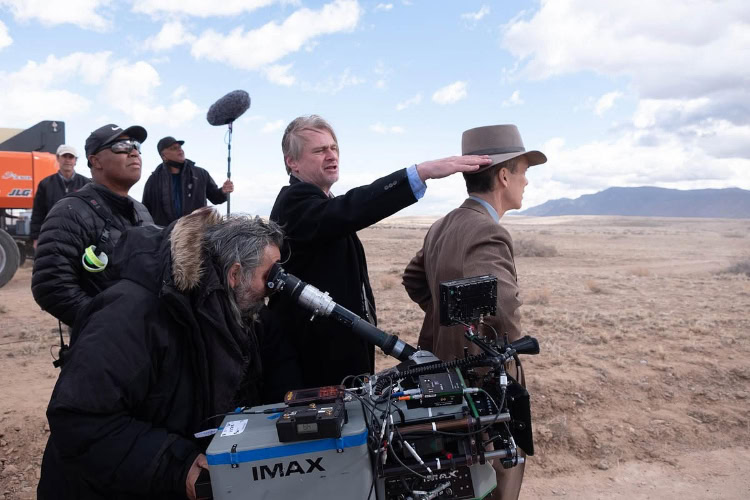
Nolan is a famous purist who refuses to shoot his movies on digital cameras. He strongly prefers traditional photochemical film and advocates for its preservation in the modern era.
He believes physical film captures light, color, and texture in a way that digital sensors simply cannot replicate. Because IMAX represents the absolute pinnacle of analog film formats, it is the ultimate tool for a director committed to maintaining the physical medium of cinema.
Working with actual film stock allows him to achieve a rich, organic look that defines his signature visual style.
Capturing Epic Scale
Nolan makes massive, highly ambitious movies that require an equally massive visual presentation. The stories he wants to tell often feature a staggering sense of size and scope.
IMAX cameras naturally lend themselves to sweeping scenery, massive architectural shots, and large scale action pieces. To him, a big story deserves to be told on the biggest canvas possible.
The enormous film frames allow him to capture towering subjects and expansive horizons without losing any minute details, perfectly matching the grand narrative ambitions of his work.
Pushing Cinematic Boundaries
Nolan actually enjoys the immense technical challenges that come with IMAX. The difficulties associated with the format push him and his crew to invent new filmmaking methods.
The cameras are notoriously bulky and heavy, with some weighing over 500 pounds. They are also incredibly loud, often sounding like a chainsaw or a sewing machine.
This extreme noise makes recording on set dialogue difficult. Furthermore, a single magazine of IMAX film only lasts about three minutes before it has to be reloaded.
Rather than seeing these as drawbacks, Nolan loves the discipline it forces on his cast and crew. He also loves working with engineers to overcome these hurdles.
Over the years, his close partnership with IMAX has led to massive innovations. These include developing the first ever black and white IMAX film stock for Oppenheimer and creating custom sound muffling blimps so the loud cameras could be used closer to actors in The Odyssey.
A Commitment to Theatrical Storytelling
Christopher Nolan views IMAX as much more than just a premium ticket format. It represents the absolute highest technical standard available for theatrical storytelling today.
By combining massive image resolution with a deeply immersive aspect ratio, he creates visual experiences that digital cameras simply cannot match. His continued reliance on traditional photochemical film forces both him and his crew to maintain incredible discipline on set.
Through careful collaboration with engineers, he constantly pushes the boundaries of what these heavy cameras can achieve. His deep dedication ensures that audiences receive the grandest visual presentation possible for modern blockbusters.
Frequently Asked Questions
Why does Christopher Nolan prefer IMAX over digital?
He believes traditional photochemical film captures light and texture better than digital sensors. IMAX 70mm provides the highest resolution available in filmmaking today. By using analog film, he maintains a rich and organic visual style that digital formats struggle to replicate completely.
What makes IMAX 70mm different from regular movie formats?
IMAX 70mm offers an incredibly tall aspect ratio and massive image resolution. This unique size fills your entire peripheral vision when projected on a proper screen. It creates a highly immersive experience that makes you feel physically present inside the movie environment.
How heavy are the IMAX cameras used in movies?
These specialized analog cameras are famously bulky and can weigh well over 500 pounds. The extreme weight makes them very difficult to move around on a film set. Directors often need custom mounts and strong crews to handle the equipment during complex scenes.
Why are IMAX cameras so loud while filming?
The loud noise comes from the massive film stock moving rapidly through the camera mechanism. They often sound similar to a loud chainsaw or a sewing machine. This extreme volume makes recording clear dialogue on set very difficult for the sound production team.
Did Christopher Nolan shoot a full movie completely on IMAX?
He achieved this major milestone with his 2026 historical epic titled The Odyssey. Prior to this project, he only shot specific action sequences of his films using the heavy cameras. Filming a complete movie in this format required new sound muffling technology.
About the Author: Julio Caesar


