
Why Is Silicon Used in Computer Chips? Explained

Every smartphone, laptop, and smart appliance powering your daily routine relies on rapid computations performed by microprocessors. The physical material driving these processors directly shapes the speed, cost, and availability of the technology you use every single hour.
For decades, silicon has remained the industry standard for manufacturing these computer chips due to its unique semiconductor properties, the protective quality of its native oxide, its immense natural abundance, and its exceptional physical stability under stress. Grasping how this single element meets such demanding mechanical and chemical requirements offers a clear window into the complex engineering and economic realities that make modern consumer electronics possible.
Key Takeaways
- Silicon is a semiconductor with a moderate bandgap, allowing engineers to precisely turn electrical currents on or off to represent binary code.
- Doping introduces specific chemical impurities, like phosphorus or boron, to create electron-rich (N-type) and electron-deficient (P-type) regions that form transistors.
- When exposed to oxygen, silicon naturally grows a native oxide layer (SiO2) that acts as an excellent electrical insulator and protects the chip during fabrication.
- As the second most abundant element in the Earth’s crust, silica is highly cost-effective and supports massive, standardized manufacturing economies of scale.
- Silicon remains highly durable under high operating temperatures and mechanical stress, preventing thermal runaway and physical breakage during daily computer use.
Fundamental Semiconductor Physics and Properties
To see why silicon dominates modern computing, one must first look at its physical nature. This element behaves differently than highly conductive metals or completely resistive materials, acting as a bridge between these two extremes.
This unique physical behavior provides the foundational control necessary to manipulate electrical signals.
Definition of a Semiconductor
A semiconductor is a material with electrical conductivity that falls between that of a conductor, such as copper, and an insulator, such as glass. Under certain conditions, it can conduct electricity; under other conditions, it acts as a barrier to electrical flow.
This variable conductivity makes semiconductors highly valuable for electronic devices, as it allows engineers to manipulate electrical currents with high precision.
The Bandgap Concept
The distinguishing feature of a semiconductor is its bandgap, which is the energy difference between its valence band (where electrons are bound to atoms) and its conduction band (where electrons can move freely to conduct electricity). In silicon, this energy gap is moderately sized.
By applying a specific voltage, engineers can push electrons across this gap to turn a current on, or withhold energy to keep it off. This ability to switch between conductive and non-conductive states represents the physical mechanism behind the binary ones and zeros of computing.
Silicon Atomic Structure
Silicon is a group 14 element with four valence electrons in its outer shell. In a pure silicon crystal, each atom shares these outer electrons with four neighboring silicon atoms, creating stable covalent bonds that form a highly organized, three-dimensional crystalline lattice.
Because all valence electrons are tightly bound in these covalent bonds, pure silicon at absolute zero is an excellent insulator. However, this stable lattice provides an ideal template for modification.
Chemical Modification of Silicon

While pure silicon is a poor conductor, its crystalline structure allows scientists to modify its electrical behavior. By introducing minute amounts of other elements into the lattice, the material can be tuned to conduct electricity in specific ways.
This process allows for the creation of positive and negative regions that interact to control currents.
The Function of Dopants
Dopants are intentional impurities added to the pure silicon crystal lattice to alter its electrical properties. Through a process called doping, engineers replace a small number of silicon atoms with atoms of other elements.
Even a tiny concentration of these dopant atoms can drastically increase the conductivity of the silicon, transforming it from a passive material into an active component of an electronic circuit.
P-Type and N-Type Semiconductor Formations
Doping creates two distinct types of semiconductor regions based on the valence electrons of the added elements. When silicon is doped with an element like phosphorus, which has five valence electrons, an extra electron is left free to move through the crystal, creating an electron-rich, negative-type (N-type) region.
Conversely, doping with an element like boron, which has only three valence electrons, leaves a vacancy known as an electron hole. This electron-deficient, positive-type (P-type) region behaves as though it has a positive charge, drawing in neighboring electrons to fill the vacancies.
Control of Electrical Conductivity
The boundary where a P-type and an N-type semiconductor meet is called a P-N junction. This junction acts as a one-way gate for electrical current.
When a voltage is applied in one direction, current flows across the junction; when applied in reverse, the current is blocked. Combining multiple junctions in specific configurations forms transistors, which serve as the fundamental switches controlling the flow of electricity throughout a computer chip.
Key Advantages of Silicon Dioxide

Beyond its electrical properties, silicon possesses a chemical attribute that sets it apart from other prospective semiconductor materials. When exposed to oxygen, it naturally forms a robust, protective chemical compound on its surface.
This chemical trait simplifies the fabrication of complex microprocessors.
Properties of the Native Oxide Layer
When silicon is exposed to oxygen at elevated temperatures, it undergoes thermal oxidation, forming a thin, highly uniform layer of silicon dioxide (SiO2) on its surface. This native oxide layer is chemically stable, adheres tightly to the silicon substrate, and forms a clean, atomically smooth interface with the underlying silicon crystal.
High-Quality Insulation Characteristics
Silicon dioxide is an exceptional electrical insulator. In a computer chip, where billions of microscopic transistors are packed tightly together, preventing unwanted electrical leakage and short circuits is critical.
The native oxide layer serves as a highly effective barrier, isolating different conductive pathways and preventing current from jumping between adjacent components.
Integration in Planar Fabrication
The ability to easily grow high-quality silicon dioxide directly on the wafer is highly beneficial for planar fabrication. During the photolithography and etching processes, the oxide layer acts as a physical mask.
It protects selected areas of the silicon from being etched away or doped, allowing manufacturers to pattern highly complex microstructures onto the chip surface with high precision.
Economic and Fabrication Benefits
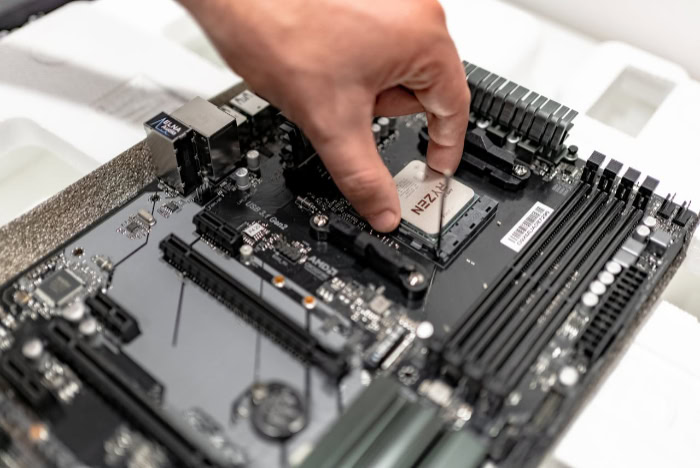
Technical performance is only part of the reason silicon remains dominant; economic factors are equally decisive. A material must be both physically capable and commercially viable to support global manufacturing.
Silicon meets both requirements, offering abundant raw material supplies and highly scalable manufacturing methods.
Natural Abundance of Silica
Silicon is the second most abundant element in the Earth’s crust, trailing only oxygen. It is rarely found in its pure form, but exists widely as silicon dioxide, commonly known as silica, which is the primary component of ordinary sand.
This abundance means that the electronics industry is not reliant on scarce, geographically restricted resources.
Cost Efficiency of Raw Materials
Because silica is so common, the cost of the raw starting material is low. While purifying sand into electronic-grade silicon requires significant energy and advanced processing, the starting point is inexpensive and readily available.
This low initial cost helps keep the baseline expenses of manufacturing silicon wafers manageable compared to more exotic semiconductor compounds.
Scalability of Production Processes
Over several decades, the semiconductor industry has standardized the methods used to grow large, single-crystal silicon ingots and slice them into thin wafers. This standardized process allows manufacturers to produce wafers of increasing size, which in turn permits more chips to be made simultaneously on a single wafer.
These standard processing techniques support massive economies of scale, driving down the cost of individual microchips.
Thermal and Mechanical Reliability

During operation, microprocessors generate heat and undergo mechanical stress during packaging and everyday use. A computer chip must withstand these harsh conditions without losing its structural form or electrical function.
Silicon provides the physical durability required to ensure that computers remain stable and reliable over time.
Performance at High Temperatures
Electronic devices naturally generate heat when current flows through their circuits. Silicon maintains its semiconductor behavior at elevated temperatures, remaining stable well past the typical operating temperatures of consumer electronics.
This thermal tolerance prevents the chip from failing under heavy processing loads, ensuring consistent performance.
Structural Integrity in Chip Production
Silicon crystals are physically strong and brittle, possessing high rigidity. This rigidity is highly beneficial during the manufacturing process, where silicon wafers must undergo intense mechanical polishing, chemical etching, and high-temperature baking.
The structural integrity of the wafers prevents warping and breakage, allowing for reliable automated handling.
Resistance to Thermal Runaway
Thermal runaway occurs when a rise in temperature causes a material’s electrical conductivity to increase excessively, drawing more current and generating even more heat until the device fails. Silicon’s moderate bandgap and thermal properties provide high resistance to this destructive loop.
It dissipates heat predictably, allowing modern cooling systems to manage thermal output effectively and protect the circuitry.
Conclusion
The dominance of silicon in modern technology rests on a unique alignment of physics, chemistry, and economics. Its moderate bandgap provides the precise electrical control needed for binary logic, while its native oxide layer naturally forms a protective, high-quality insulating barrier.
Combined with its extreme natural abundance and exceptional mechanical strength under high temperatures, these properties make the material both technically superior and commercially viable. This single element successfully paved the way for the microelectronics era, transforming room-sized computers into pocket-sized devices.
Today, silicon remains the undisputed foundation of global computing, driving the processors that run our modern systems.
Frequently Asked Questions
Why do computer manufacturers use silicon instead of metal?
Silicon is used instead of metal because it is a semiconductor that can switch between conducting and blocking electricity. Metals conduct electricity constantly, which makes them impossible to use as the switches that form computer code. Silicon can be chemically altered to control this flow, allowing us to build the microscopic switches known as transistors.
Is silicon the same thing as the silicone used in sealants?
No, silicon is a naturally occurring chemical element, while silicone is a synthetic plastic-like compound. Pure silicon is a crystalline metalloid element refined from silica sand for use in microchips. Silicone is a human-made polymer made of silicon, oxygen, carbon, and hydrogen used in waterproof sealants, lubricants, and kitchen utensils.
Where does the silicon for computer chips come from?
The silicon used for computer chips comes from high-purity quartz sand, which is rich in silica. This raw sand is melted and chemically refined in industrial furnaces to remove all impurities. The resulting ultra-pure silicon is then grown into massive single-crystal cylinders and sliced into the thin wafers used for chip manufacturing.
Why does a computer chip need an oxide layer?
A computer chip needs an oxide layer to act as an electrical insulator that prevents short circuits. Because billions of tiny components are packed together on a single chip, electricity can easily leak between adjacent pathways. The native silicon dioxide layer blocks this unwanted flow, keeping electrical signals on their correct paths.
Can computer chips melt if they get too hot?
Silicon computer chips will not physically melt under normal operating conditions because the material has an extremely high melting point of over 1,400 degrees Celsius. However, extreme heat will cause the chip to fail electrically before it physically melts. High temperatures disrupt the semiconductor properties, causing errors and eventual system shutdown.
About the Author: Elizabeth Baker


