
Indoor vs. Outdoor TV Antenna: Which One Do You Need?

Over-the-air (OTA) broadcast television delivers free, uncompressed high-definition local news, live sports, and major network programming directly to modern homes without monthly subscription fees. Selecting the right equipment to capture those signals presents a primary trade-off between setup convenience and reception power.
Compact indoor units offer quick installation and minimal visual clutter, yet they frequently struggle with physical obstructions and distant transmitters. Large outdoor arrays demand roof or mast mounting and dedicated cable routing, but they reward the extra effort with superior range and dependable channel stability.
Evaluating signal performance, broadcast frequency mechanics, building materials, property regulations, and installation demands ensures households choose the ideal antenna setup for their specific location and viewing habits.
Key Takeaways
- Choose an indoor antenna only if your home sits within 15 to 25 miles (24 to 40 kilometers) of local broadcast towers and has an unobstructed window facing the transmitters.
- Install a rooftop or mast-mounted outdoor antenna when towers are 30 to 70 miles (48 to 113 kilometers) away, or when hills, dense trees, brick walls, and Low-E glass windows block incoming signals.
- Verify that your chosen hardware includes longer dipole elements to capture Very High Frequency (VHF) channels 2 through 13, as many flat indoor panels only receive Ultra High Frequency (UHF) channels 14 through 36.
- Connect a single high-gain outdoor antenna to a distribution amplifier and coaxial splitter to feed multiple televisions across an entire house without paying for individual room units.
- Exercise your federal rights under the FCC Over-the-Air Reception Devices (OTARD) rule, which protects both homeowners and renters who mount outdoor antennas on roofs, balconies, or exclusive-use patios.
Signal Range and Broadcast Mechanics
Broadcast television relies on radio frequency waves traveling from transmission towers to receiving elements at a viewer’s home. Physical distance, mounting height, and specific channel frequencies dictate how much hardware power is necessary to lock onto a clear, uninterrupted picture.
Distance to Broadcast Towers
Radio waves weaken as they travel through the atmosphere, establishing a direct correlation between transmitter distance and required antenna sensitivity. Standard indoor antennas reliably capture broadcasts within a 15 to 25 mile (24 to 40 kilometer) radius of a transmission tower, despite marketing claims that often advertise inflated ranges.
Large outdoor directional arrays are engineered to pull in signals from 30 to 70 miles (48 to 113 kilometers) away. At the outer fringes of a broadcast zone, digital television experiences a rapid drop-off known as the digital cliff effect; instead of showing gradual snowy static like older analog broadcasts, a weak digital signal causes severe pixelation, audio dropouts, or a completely blank screen.
Line of Sight and Elevation
Over-the-air television signals travel in straight lines from the broadcast tower to the receiving element, making vertical placement one of the most effective ways to improve reception. Over long distances, the physical curvature of the Earth begins to block direct line-of-sight paths, typically limiting horizon-level reception beyond 40 to 50 miles (64 to 80 kilometers).
Placing an indoor antenna at ground level or on a first-floor media console leaves it vulnerable to neighboring houses, parked vehicles, and privacy fences. Elevating an outdoor antenna 20 to 30 feet (6.1 to 9.1 meters) above the ground on a rooftop mast clears immediate neighborhood obstacles and extends the visible radio horizon.
VHF and UHF Frequency Reception
Television broadcasts operate across two primary frequency bands: Very High Frequency (VHF), covering channels 2 through 13, and Ultra High Frequency (UHF), covering channels 14 through 36. While a majority of modern digital stations broadcast on the UHF band using shorter wavelengths, many major network affiliates still transmit on High-VHF (channels 7 through 13) or Low-VHF (channels 2 through 6).
Because VHF radio waves are physically longer, measuring between 4.5 and 18 feet (1.4 and 5.5 meters) in wavelength, capturing them requires wider metal rods or extendable rabbit-ear dipoles. Compact indoor flat panels often lack sufficient element length for VHF signals, whereas dual-band outdoor antennas integrate both small UHF loops and wide VHF rods into a single frame.
Indoor Antennas: Characteristics and Limitations

Indoor antennas are built for simplicity, affordability, and discreet placement inside living spaces. While they serve metropolitan households well, their compact dimensions and interior locations introduce distinct operational limits.
Form Factors and Design Types
Modern indoor units generally fall into three categories: paper-thin flat panels that tape to walls or windows, freestanding tabletop units with telescopic rabbit ears, and amplified models equipped with inline USB or AC signal boosters. Inside a flat panel, thin stamped-foil or printed-circuit elements capture incoming UHF waves.
Most flat panels are bidirectional, pulling in signals from their front and back faces, while multi-directional or omnidirectional tabletop models receive broadcasts from 360 degrees at the cost of lower peak gain. Manufacturers prioritize sleek plastic enclosures, paintable surfaces, and low-profile stands so the hardware blends quietly beside flat-screen televisions and modern interior home décor.
Key Advantages for Urban Dwellers
City residents living close to transmission hubs benefit from a straightforward plug-and-play installation process. A user simply screws the attached coaxial cable into the television’s antenna port, positions the unit, and runs a 3-minute automatic channel scan through the television menu.
Quality indoor models cost between $15 and $60, requiring zero ongoing maintenance fees or auxiliary mounting hardware. Furthermore, keeping all equipment inside the living room ensures total compliance with strict apartment leases, condominium bylaws, and historic district rules that prohibit drilling through exterior walls or accessing shared rooftops.
Vulnerabilities to Interior Interference
Operating an antenna inside a home exposes it to electromagnetic interference generated by everyday electronics. Microwave ovens, LED light bulbs, desktop computers, and Wi-Fi routers emit radio frequency noise that can overpower weak television broadcasts, especially when a cheap inline amplifier boosts noise alongside the desired signal.
To minimize indoor attenuation, users frequently have to mount the antenna high on an exterior window facing the local broadcast towers, leaving trailing coaxial cables visible across the wall. Even with careful window placement, human bodies and pets walking across the room can temporarily block or reflect radio waves, causing brief audio stutters or video freezing.
Outdoor Antennas: High-Performance Capabilities

When distance or local obstructions defeat compact interior hardware, outdoor antennas provide the physical surface area and elevation required for dependable television reception. Mounted on roofs, gables, or dedicated masts, exterior systems maximize signal capture and support whole-home viewing.
Multi-Directional and High-Gain Hardware
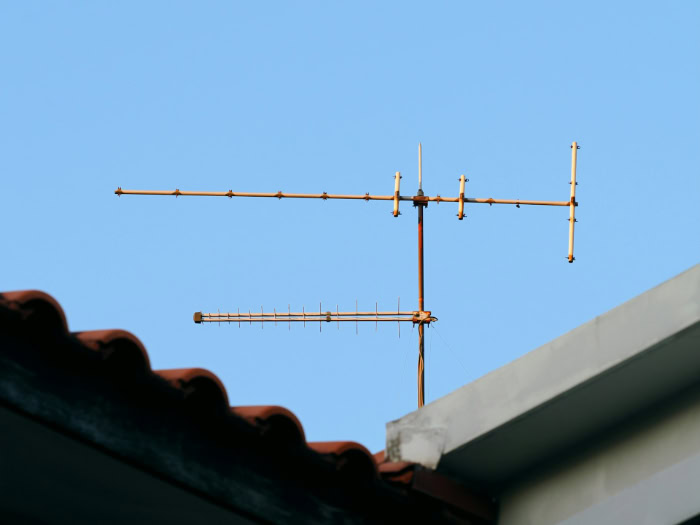
Outdoor television antennas utilize specialized structural geometries to maximize signal capture. Traditional directional Yagi designs feature a long central boom measuring 4 to 10 feet (1.2 to 3.0 meters) lined with parallel metal elements that focus reception along a narrow beam, while multi-bay bowtie arrays stack multiple receiving elements on a vertical reflector grid to capture wider signal paths.
High-gain outdoor elements passively concentrate weak radio waves, providing 8 dBi to 15 dBi of forward gain to pull in distant transmitters without introducing electronic amplifier noise. When a household sits between two separate media markets with broadcast towers in divergent directions, installers can combine multi-directional bay panels or attach a motorized mast rotator to turn the antenna toward different compass headings via a handheld remote.
Signal Distribution Across Multiple Televisions
A single roof-mounted antenna can feed live broadcasts to every room in a house by connecting directly into the existing RG6 coaxial wiring network often left behind by former cable or satellite providers. Because splitting a coaxial line reduces signal strength by roughly 3.5 dB on a two-way splitter and 7 dB on a four-way splitter, multi-room setups frequently incorporate a powered distribution amplifier at the junction box to offset line loss and long cable runs exceeding 50 feet (15.2 meters).
Centralizing reception through one outdoor array eliminates the clutter and expense of buying, positioning, and tuning separate indoor antennas for three or four individual televisions.
Weather Exposure and Electrical Ground Requirements
Because exterior hardware remains exposed to the elements year-round, quality outdoor antennas use anodized aluminum elements, UV-stabilized plastics, and weatherproof balun housings to resist heavy rain, ice buildup, corrosion, and wind gusts exceeding 70 mph (113 km/h). Beyond mechanical durability, mounting metal equipment high above a roofline introduces serious electrical safety requirements.
In the United States, Article 810 of the National Electrical Code mandates proper grounding for all outdoor masts and coaxial lead-in cables. Installers must drive an 8-foot (2.4-meter) copper grounding rod into the earth or bond the system to the home’s main electrical service ground, routing both a 10-gauge copper wire from the mast and the coaxial cable through a listed grounding block to safely dissipate static wind charges and nearby lightning surges.
Architectural, Environmental, and Legal Constraints

Signal distance only tells part of the reception story. Building construction materials, surrounding geography, and property rules heavily influence how a household chooses between an indoor unit and an exterior array.
Construction Material Obstacles
Before radio waves ever reach an indoor antenna, they must pass through the exterior shell of a building. Dense masonry materials like brick and concrete block attenuate incoming signals significantly, while traditional stucco applied over galvanized wire mesh acts like a Faraday cage that blocks radio frequencies almost completely.
Foil-backed foam insulation boards inside walls reflect signals away from interior rooms in a similar manner. Even placing an indoor panel directly on glass can fail in newer homes equipped with Low-E (low-emissivity) energy-efficient windows, which contain a microscopic metallic oxide coating that reflects both solar heat and television broadcasts.
Similarly, standing-seam metal roofs and radiant barrier roof decking severely degrade reception for both living room and attic antennas, making an exterior mount the only viable option.
Natural Terrain and Dense Foliage
Local topography and vegetation create significant hurdles for line-of-sight radio waves. Homes located on the far side of steep hills, inside deep valleys, or behind rocky ridges suffer from terrain shadowing, where broadcast signals are deflected upward or scattered before reaching ground level.
Dense forests and mature neighborhood trees also absorb and scatter high-frequency UHF signals. Because water readily absorbs radio energy, households surrounded by deciduous trees often experience reliable reception during winter months, only to lose channels in the spring when sap rises and wet leaves fill the canopy.
Raising an outdoor antenna on a telescopic mast or chimney bracket 10 to 20 feet (3.0 to 6.1 meters) above the roofline helps clear nearby gables and thin out the path through surrounding foliage.
Homeowner Association Rules and Tenant Rights
Many homeowners and renters falsely assume that community covenants or landlord rules prohibit outdoor television antennas. Under the Federal Communications Commission (FCC) Over-the-Air Reception Devices (OTARD) rule, federal law invalidates local ordinances, Homeowner Association (HOA) restrictions, and lease clauses that impair a resident’s ability to install, maintain, or use an antenna designed to receive local television broadcasts.
The protection covers masts and antennas measuring 3.3 feet (1 meter) or less in diameter or diagonal measurement, along with traditional television antennas of standard size mounted on property within the resident’s exclusive use or control. Homeowners have the legal right to mount antennas on their roofs or yards, while apartment tenants can place compact outdoor units on private balconies, decks, or patios using non-penetrating weighted tripod stands, though shared common areas like apartment roofs and exterior building walls remain off-limits without landlord permission.
Comparative Evaluation and Hybrid Solutions
Selecting the right broadcast hardware requires matching local signal data against your home’s layout and budget. By analyzing transmitter maps and considering intermediate mounting locations, consumers can avoid overspending on unnecessary gear or buying underpowered units.
Reception Maps and Tower Proximity Checks
Before purchasing any equipment, residents should run a free address check using online broadcast databases such as the FCC DTV Reception Maps or RabbitEars.info. Entering a street address and mounting height generates a detailed report showing every available station, its actual RF broadcast channel (which determines VHF versus UHF hardware needs), the exact magnetic compass heading toward each tower, and estimated signal field strength measured in decibels above one microvolt per meter.
Stations rated as “Good” or highlighted in green with line-of-sight paths under 20 miles (32 kilometers) generally work with an indoor antenna. Channels marked as “Fair,” “Poor,” or obstructed by terrain edges require a high-gain attic or rooftop array aimed precisely along the listed compass heading.
Attic Placement as an Intermediate Choice
Mounting a full-sized outdoor antenna inside an unfinished attic serves as a practical middle ground between living room convenience and rooftop elevation. An attic installation raises the receiving elements 15 to 25 feet (4.6 to 7.6 meters) above ground level while keeping all hardware completely sheltered from wind, rain, ice, and lightning strikes.
Homeowners avoid climbing onto steep roofs, drilling weatherproofed holes through exterior siding, or installing external grounding rods, and neighborhood aesthetics remain completely untouched. However, passing through asphalt shingles, plywood decking, and wooden rafters reduces incoming signal strength by roughly 30% to 50% (approximately 3 dB to 6 dB), making attic setups unsuitable for weak fringe signals or homes built with foil-backed roof decking, clay tiles, or metal roofing.
Cost Analysis and Installation Demands
Upfront costs and labor demands differ sharply between the two antenna categories. A basic indoor unit costs $15 to $60 and requires zero tools or physical exertion.
Conversely, a complete outdoor setup includes a $60 to $200 antenna, a $25 to $50 J-pole or tripod mount, 50 to 100 feet (15.2 to 30.5 meters) of weatherproof RG6 coaxial cable costing $20 to $40, and $30 to $50 worth of grounding blocks, copper wire, and masonry anchors. Do-it-yourself rooftop installation requires an extension ladder, a power drill, a wrench set, roof sealant, and comfortable balance working at heights.
Hiring a professional low-voltage or satellite installer typically adds $150 to $400 in labor, an investment that quickly pays for itself when dealing with two-story rooflines, complex multi-room wiring, or cancelled cable bills exceeding $100 per month.
Conclusion
Choosing between an indoor and an outdoor TV antenna comes down to balancing urban convenience against suburban and rural reception power. Indoor antennas provide an affordable, drill-free solution for city dwellers and apartment renters located within 20 miles (32 kilometers) of broadcast towers where signals are strong and unobstructed.
Outdoor antennas require higher upfront hardware costs, physical mounting work, and proper electrical grounding, yet they remain unmatched for capturing distant stations, overcoming dense foliage or hilly terrain, and feeding multiple televisions across a whole home.
Before purchasing your equipment, work through a quick four-step evaluation checklist:
- Check Tower Distance and Direction: Run an online reception report for your exact street address to see if local stations sit within indoor range or require a directional outdoor array.
- Confirm Frequency Bands: Look at the RF channel numbers for your favorite local networks and make sure your antenna includes wide VHF elements if any stations broadcast on channels 2 through 13.
- Inspect Building Materials: Rule out indoor or attic placements if your home features brick or stucco siding, Low-E coated windows, foil-backed insulation, or a metal roof.
- Match Budget and Mounting Options: Weigh a $15 to $60 plug-and-play indoor unit against a $150 to $500 attic, balcony, or rooftop installation based on how many televisions you plan to connect and how long you intend to stay in the residence.
Frequently Asked Questions
Do I need a special TV antenna to get 4K channels?
No, any working indoor or outdoor TV antenna can receive 4K over-the-air broadcasts without hardware upgrades. Antennas capture radio frequencies rather than specific video resolutions, so standard models pick up NextGen TV (ATSC 3.0) signals effortlessly. You only need a television with an ATSC 3.0 tuner or an external converter box.
Will a signal amplifier help my indoor antenna get more channels?
An amplifier only helps compensate for signal loss across long coaxial cable runs, as it cannot pull in broadcasts that the antenna element itself fails to capture. Using a booster within 15 miles (24 kilometers) of local towers often overloads your television tuner and amplifies electronic noise, causing channels to drop out.
Can I connect an outdoor TV antenna to my existing satellite dish wiring?
Yes, you can reuse the RG6 coaxial cables and mounting mast from a retired satellite dish to install an outdoor TV antenna. Simply unbolt the old satellite dish reflector, mount your television antenna to the existing J-pole mast, and connect the coaxial lead directly to your antenna after removing any satellite-specific power inserters.
Does bad weather ruin outdoor TV antenna reception?
Heavy rain and snow rarely block over-the-air television frequencies directly, though high winds can cause reception dropouts by blowing nearby tree branches into the signal path. Wet leaves and swaying limbs scatter UHF radio waves, while loose coaxial fittings or unstable antenna masts can temporarily break your alignment with distant broadcast towers during severe storms.
Why am I missing major network channels like ABC, NBC, or CBS on my flat indoor antenna?
You are likely missing major networks because those stations often broadcast on the VHF band (channels 2 through 13), which thin flat antennas struggle to capture. Most flat indoor panels are built primarily for UHF waves, so switching to a rabbit-ear model or a dual-band outdoor antenna will restore those VHF channels.
About the Author: Julio Caesar


