
QR Codes vs. Barcodes: How They Fit Different Needs

A single misread scan at a shipping terminal can delay thousands of dollars in cargo for days. For any professional managing inventory or customer outreach, selecting the wrong visual data format creates unnecessary friction in every transaction.
While the thin lines of a traditional barcode and the complex squares of a QR code might seem like interchangeable tools, they operate on entirely different mechanical principles. One prioritizes the rapid fire of a warehouse laser while the other speaks directly to the camera in every consumer’s pocket.
Key Takeaways
- Barcodes store data horizontally in a 1D format, while QR codes store information both vertically and horizontally in a 2D matrix.
- A standard barcode is limited to about 25 characters of text, but a QR code can hold over 4,000 alphanumeric characters or 3,000 bytes of binary data.
- QR codes feature Reed Solomon error correction, which allows them to be scanned successfully even if thirty percent of the image is damaged or obscured.
- Traditional 1D barcodes require specialized laser scanners and precise horizontal alignment, whereas QR codes can be scanned from any angle using common smartphone cameras.
- Logistics firms use barcodes for rapid, high volume SKU tracking, while marketers use QR codes for interactive content like digital menus, payment links, and website redirects.
Structural Differences and Dimensionality
The fundamental difference between these two technologies lies in how they occupy physical space. While one relies on a simple horizontal sequence, the other utilizes a complex grid system to maximize the surface area of a label.
These design choices determine not only how much data a code can hold but also how a scanner interprets the signals it receives.
Linear Barcodes and the One-Dimensional Design
The one-dimensional barcode is often described as a picket fence because of its vertical black lines and white spaces. Data is encoded solely in the horizontal dimension.
A scanner reads the varying widths of these lines and gaps to identify a specific string of numbers or letters. Because the information is only stored along a single axis, the code must be long enough to accommodate all the characters, which often limits its use to simple identification numbers.
Matrix QR Codes and Two-Dimensional Grids
A Quick Response code operates in two dimensions; data is arranged in a square grid of small black and white blocks called modules. By storing information both horizontally and vertically, these codes pack significantly more data into the same amount of space.
This matrix structure allows the code to be read from any orientation, as the scanner identifies the three large squares in the corners to orient itself.
Encoding Methods and Visual Translation
Both formats use a binary system to represent data, where black and white areas correspond to zeros and ones. In a barcode, the thickness of a bar determines the specific character it represents.
In a QR code, the arrangement of pixels within the grid creates a pattern that a processor translates into text or binary data. This mathematical translation ensures that even complex sets of instructions can be compressed into a small visual footprint.
Data Capacity and Information Type

The utility of a scanning format is largely defined by the volume and variety of information it can carry. While one format acts as a simple pointer to a database, the other can serve as a portable database itself.
This distinction determines whether a code is used merely to identify an object or to provide a complete digital experience.
Quantitative Limitations and Character Limits
Traditional barcodes are limited by their linear nature, typically holding between 20 and 25 characters. Attempting to add more data makes the barcode physically wider, eventually making it too large to fit on small packaging or too difficult for standard scanners to read.
QR codes do not suffer from this constraint to the same degree; they can hold over 4,000 alphanumeric characters or nearly 3,000 bytes of binary data in a compact square.
Information Diversity and Complex Data
Because of their small capacity, barcodes are almost exclusively used for numeric or alphanumeric identification codes, such as a serial number or a Global Trade Item Number. QR codes can store a much wider range of information.
This includes website URLs, contact information in the form of vCards, GPS coordinates, or even plain text paragraphs. This versatility allows the code to trigger actions on a device, such as opening a browser or adding a calendar event.
Static versus Dynamic Capabilities
Barcodes are static, meaning the data is printed directly into the pattern and cannot be changed. If the information associated with a barcode needs an update, the label must be reprinted.
QR codes can be generated as dynamic codes. These use a redirect URL, allowing the owner to change the destination data at any time without altering the printed code itself.
This provides a level of flexibility that is impossible with linear formats.
Scanning Mechanics and Durability

The environment in which a code is scanned often dictates which format is more effective. Factors such as lighting, distance, and physical damage can render a code unreadable if the technology is not matched to the surroundings.
The mechanics of the scanning process differ greatly between the two, particularly in how they handle interference and orientation.
Directionality and Alignment Constraints
Standard barcodes require a specific alignment to function. A laser scanner must pass across the entire width of the code in a straight line.
If the scanner is tilted or the label is turned vertically, the laser cannot capture the full data string. QR codes offer omnidirectional scanning, meaning they can be read from any angle.
The internal patterns allow the software to instantly correct the orientation of the image, making it much faster to scan in fast-paced environments.
Error Correction and Resilience
One of the most significant advantages of the QR format is its built-in error correction. Using the Reed-Solomon mathematical algorithm, a QR code can sustain significant damage or obscuration and still remain functional.
Depending on the setting, a code can be missing up to thirty percent of its surface area and still provide a successful scan. A traditional barcode lacks this redundancy; a single scratch across the lines can break the data string and cause a failure.
Scanning Distance and Environmental Lighting
Distance and light sensitivity vary between these formats based on the scanning hardware used. Traditional barcodes are highly effective at long distances when paired with powerful laser scanners, which is useful in large warehouses with high shelving.
QR codes rely on image sensors, which require decent lighting and a clear focus to resolve the small blocks in the grid. While high-resolution cameras have narrowed this gap, barcodes remain a reliable choice for long-range industrial applications.
Hardware Requirements and Accessibility
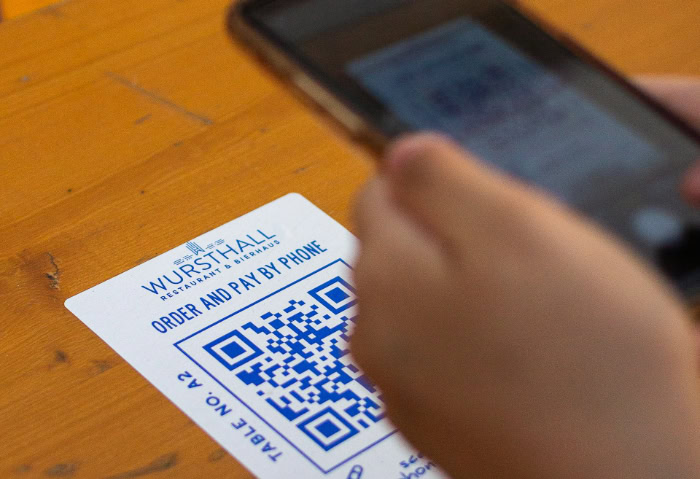
The choice between these formats often comes down to the equipment already available or the cost of new infrastructure. Some systems require specialized, rugged tools built for speed, while others leverage the hardware that billions of people already carry in their pockets.
Specialized Readers and Industrial Hardware
Linear barcodes are primarily read by laser scanners or Charge-Coupled Device (CCD) readers. These devices are designed for high-speed repetition, often found at grocery store checkouts or on assembly lines.
They are highly efficient at reading one-dimensional patterns but are generally incapable of interpreting the complex two-dimensional data found in QR codes. This creates a dependency on dedicated hardware that must be maintained and replaced over time.
Universal Accessibility through Smartphones
QR codes gained massive popularity because they do not require specialized hardware. Most modern smartphone cameras have native support for scanning 2D codes, turning every consumer into a potential user.
This accessibility has moved data scanning out of the warehouse and into the public sphere. Because it relies on software-based image processing rather than a physical laser, the technology is available to anyone with a mobile device.
Cost of Implementation
For a business, the financial investment differs between these two systems. Implementing a barcode system often involves purchasing expensive handheld scanners and integrating them into a local network.
Conversely, a QR-based system can often be deployed using existing mobile devices or low-cost tablets. While industrial scanners are faster for high-volume tasks, software-based solutions for QR codes offer a lower barrier to entry for small businesses or public-facing campaigns.
Strategic Use Cases and Industry Applications

Selecting the right code depends on the specific goals of an operation. While one is optimized for the invisible background tasks of logistics, the other is designed for interaction and engagement.
Understanding where each format excels prevents technical bottlenecks and ensures that the end-user has a seamless experience.
Retail and Logistics Standards
In the world of inventory management, the barcode remains the standard. Its ability to be read quickly by high-speed lasers makes it ideal for Point-of-Sale (POS) systems and warehouse sorting.
When a worker needs to scan hundreds of items per hour, the simplicity and speed of the 1D barcode are hard to beat. It is the most efficient tool for tracking Stock Keeping Units (SKUs) where only a simple identification number is required to link an item to a database.
Marketing and Consumer Engagement
QR codes have found their primary home in marketing and customer service. Because they can store URLs, they are used for digital menus in restaurants, promotional links on billboards, and “scan-to-pay” mobile payments.
This format bridge the gap between physical objects and digital content. A customer can scan a code on a product’s packaging to watch a video tutorial or sign up for a newsletter, creating a direct line of communication that a simple barcode cannot provide.
Internal Asset Management
For internal operations, the choice depends on the depth of information needed on-site. Companies often use barcodes for tracking office equipment or furniture because they only need to link the item to an internal inventory list.
However, for document archiving or maintenance of complex machinery, QR codes are often preferred. A technician can scan a QR code on a piece of equipment to immediately access its entire repair history or a PDF manual without needing to consult a separate computer system.
Conclusion
The choice between 1D and 2D scanning technology depends entirely on the operational environment and the intended user. Barcodes remain the most effective tool for high volume logistics where speed and simple identification are the only priorities.
They offer a reliable, cost effective way to manage stock using dedicated hardware that can withstand the rigors of a warehouse. Meanwhile, QR codes provide a superior solution for information density and public accessibility, allowing anyone with a smartphone to access complex digital resources.
By offering error correction and omnidirectional scanning, QR codes ensure that data remains reachable even in less than ideal conditions. Selecting the correct format requires a balance between the need for rapid tracking and the desire for deeper data integration.
Frequently Asked Questions
Can I scan a QR code with a regular barcode scanner?
No, most standard laser barcode scanners cannot read QR codes because they only track data in a straight line. QR codes require an imaging scanner or a camera that can capture the entire grid at once. You would need to upgrade to a 2D imager to support both formats.
Do QR codes still work if they get scratched or dirty?
Yes, QR codes are designed to remain functional even when they are partially damaged or dirty. They use built-in error correction algorithms that can recover data if up to thirty percent of the square is unreadable. This makes them much more durable for outdoor use than traditional linear barcodes.
Why are barcodes still used if QR codes hold more data?
Barcodes are still the standard for high speed retail and warehouse environments because laser scanners can read them almost instantly. They are cheaper to print on a large scale and do not require the complex image processing that a camera needs. For simple identification tasks, the 1D format is more efficient.
Can I change the link in a QR code after I print it?
You can change the destination of a QR code only if you use a dynamic format that utilizes a redirect URL. Standard barcodes and static QR codes have their information permanently embedded in the printed pattern. Dynamic codes allow businesses to update menus or links without reprinting their materials.
Is it more expensive to use QR codes for my business?
Implementing QR codes is often cheaper for small businesses because they can be scanned with existing smartphones instead of specialized industrial hardware. While professional 2D imaging scanners cost more than basic laser scanners, the ability to use mobile devices significantly lowers the initial investment required for inventory or marketing.
About the Author: Julio Caesar


