
How Undersea Cables Power the Global Internet: Explained

Sending a message on a smartphone or streaming a movie over Wi-Fi creates the illusion that global data floats effortlessly through the air. In reality, the cloud sits at the bottom of the ocean.
Nearly all international communications travel through physical wires resting on the seafloor. The global submarine network consists of hundreds of fiber-optic cables stretched across hundreds of thousands of miles, carrying 95% to 99% of all transoceanic data traffic.
Without those submerged links, international banking, video calls, and overseas web browsing would grind to an immediate halt. Inside the lines, lasers fire pulses of light through ultra-pure glass fibers, while specialized maritime crews place and repair the network across deep underwater terrain, and major corporations compete to control the vital global infrastructure.
Key Takeaways
- Undersea fiber-optic cables carry 95% to 99% of all transoceanic digital traffic, outperforming satellites in both bandwidth capacity and transmission speed.
- Deep-sea cables are roughly the width of a garden hose, measuring about 1 inch in diameter, because the calm abyssal plain requires far less steel armor than shallow coastal waters.
- Optical amplifiers spliced into the cable every 40 to 60 miles (64 to 97 kilometers) use high-voltage electricity fed from the shore to boost weakening light signals across the ocean.
- Human activity causes the vast majority of cable breaks, with dropped ship anchors and commercial fishing trawlers damaging lines far more often than earthquakes or marine life.
- Major technology companies like Google, Meta, Amazon, and Microsoft now fund and own most new subsea routes to support cloud computing and artificial intelligence workloads.
The Invisible Backbone of Global Data
Every international tap, click, and swipe relies on a vast network of submerged cables connecting the continents. While everyday consumer devices cut the cord decades ago, the core infrastructure of the internet remains thoroughly wired.
The Myth of the Wireless Cloud
When a user sends an email or loads a webpage on a phone, the signal travels wirelessly only for the very first leg of its trip. Radio waves carry the data from the device to the nearest Wi-Fi router or local cellular tower, often located just a few hundred feet away.
Once the signal hits that tower or router, it immediately enters a buried network of terrestrial copper and fiber-optic lines. If the destination server sits across an ocean, local internet service providers route the data toward the coast, handing off international emails, video streams, and financial transactions to high-capacity undersea pathways.
Undersea Fiber Versus Satellites
While satellite internet constellations provide valuable coverage to remote regions, satellites handle less than 1% of global data traffic. Undersea fiber-optic cables dominate international communications because of sheer bandwidth capacity and the physics of latency.
Modern submarine cables can carry hundreds of terabits per second, whereas satellites are limited by radio spectrum constraints. Furthermore, signals beamed to geostationary satellites must travel 22,236 miles (35,786 kilometers) into space and the same distance back to Earth, creating a noticeable delay.
Even low-Earth orbit satellites cannot match the volume and speed of glass fibers laid directly across the ocean floor. Subsea cables are also far more cost-effective per gigabit and remain completely immune to atmospheric weather disruptions like heavy rain or solar storms.
Evolution from Copper Telegraph to Modern Fiber
Submarine communications began in the 1850s, when engineers laid the first transatlantic telegraph cables using copper wires insulated with natural rubber latex called gutta-percha. Those early lines took several minutes just to transmit a single Morse code character between North America and Europe.
In the mid-20th century, the industry transitioned to coaxial telephone cables, starting with the first transatlantic telephone cable in 1956, which carried 36 simultaneous voice calls. The modern internet era became possible in the late 1980s with the installation of the first transoceanic fiber-optic cable in 1988, replacing electrical currents in copper with high-speed light pulses in glass.
Anatomy and Science of a Submarine Cable
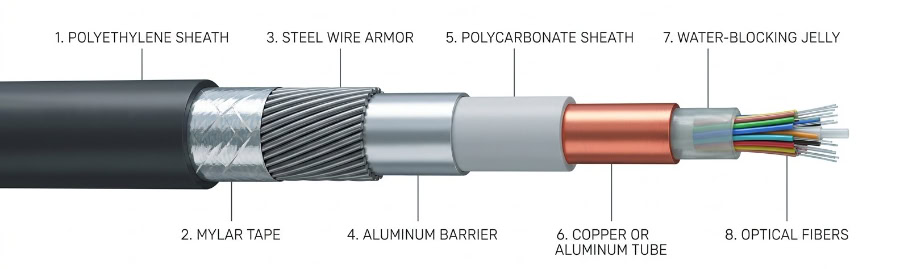
A submarine communications cable is a piece of precision engineering designed to survive crushing water pressure, salt corrosion, and abrasion for at least 25 years. Inside its protective casing, optical physics and high-voltage electrical systems work together to move data across thousands of miles.
Pulses of Light and Fiber-Optic Physics
At the center of a submarine cable sit several pairs of optical fibers, each no thicker than a human hair. Transmitters on land use rapid-fire lasers to convert digital data into billions of light pulses per second.
These pulses shoot down strands of ultra-pure silica glass. The core of each fiber is surrounded by a glass cladding with a lower refractive index, which bends the light inward and keeps it trapped inside the core through a principle called total internal reflection.
Because light slows down when moving through solid glass, signals travel through the cable at roughly two-thirds the speed of light in a vacuum, or about 124,000 miles (200,000 kilometers) per second.
Protective Layers and Structural Design
To protect the delicate glass fibers from the harsh marine environment, manufacturers wrap them in multiple concentric layers of armor and insulation. The glass strands sit inside a small tube filled with water-blocking petroleum jelly.
That core is encased in a seamless copper or aluminum tube, followed by a layer of polycarbonate plastic, stranded steel wires for tensile strength, and an outer jacket of tough polyethylene. Surprisingly, deep-sea cables are only about the width of a garden hose, measuring roughly 1 inch in diameter.
In shallow coastal waters where hazards are common, engineers add multiple layers of heavy galvanized steel wire and tar-soaked nylon yarn, making the cable as thick as a human arm at up to 3 inches in diameter.
Optical Amplifiers and High-Voltage Power
Even inside ultra-pure glass, light gradually scatters and loses intensity over long distances. To prevent the signal from fading out, engineers splice optical amplifiers, known as repeaters, into the cable every 40 to 60 miles (64 to 97 kilometers).
Instead of converting light back into electricity, these repeaters pass the weakened signal through a section of fiber infused with a rare-earth element called erbium. Pump lasers inside the repeater excite the erbium atoms, boosting the optical signal back to full strength instantly.
To run these underwater lasers, coastal stations feed up to 10,000 volts of direct current electricity down the cable’s copper layer. Because the copper tube is sealed inside thick polyethylene insulation, the electric current poses no danger to fish or marine mammals.
Coastal Gateways and Terrestrial Connections
When an undersea cable reaches its destination, it comes ashore through a buried concrete chamber on the beach called a beach manhole. From there, the line runs underground into a secure coastal facility known as a cable landing station.
These buildings house the high-voltage power supply equipment and the optical terminals that separate the incoming light signals into distinct data streams. Acting as the bridge between oceanic and land-based networks, coastal gateways connect submarine routes directly to local internet service providers, financial exchanges, and inland data centers.
Ocean Floor Surveys and Cable Installation
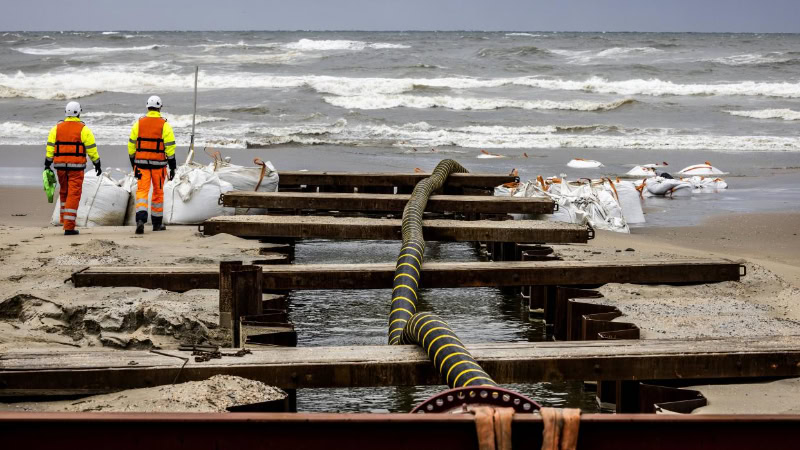
Laying a continuous line of glass and steel across an ocean basin requires months of preparation and specialized maritime operations. Engineers must treat the seafloor with the same care used to build a highway across a mountain range.
Seabed Maps and Route Selection
Before a single foot of cable enters the water, survey vessels spend months mapping the proposed route using multibeam sonar and underwater cameras. Marine geologists and engineers analyze the depth, slope, and sediment composition of the ocean floor.
The goal is to select a flat, stable pathway that avoids active underwater volcanoes, hydrothermal vents, jagged coral reefs, and steep submarine canyons prone to rockslides. Planners also route cables away from known shark habitats, offshore oil rigs, and busy commercial shipping anchorages.
Specialized Vessels and Maritime Logistics
Once the route is finalized, factories load the finished cable straight into the hulls of massive, purpose-built cable ships. These vessels feature giant circular holding tanks capable of storing thousands of miles of coiled cable weighing several thousand tons.
During deployment, the ship uses dynamic positioning thrusters linked to satellite navigation to hold a precise course regardless of wind or ocean currents. Cable installation is a slow, continuous operation; the vessel travels at a walking pace of 1 to 2 miles (1.6 to 3.2 kilometers) per hour, staying at sea for weeks or months at a time until the transoceanic link is complete.
Shallow-Water Plows Versus Deep-Sea Placement
Installation methods change dramatically depending on water depth. From the shoreline out to depths of about 3,300 feet (1,006 meters), human maritime activity poses a constant threat.
In these shallower zones, the ship tows a heavy underwater plow along the seabed. High-pressure water jets on the plow cut a narrow trench, tucking the heavily armored cable 3 to 10 feet (0.9 to 3 meters) beneath the mud and sand before the sediment settles back over it.
Once the ship reaches the deep ocean, where depths exceed 13,000 feet (3,962 meters), burial is unnecessary. Crews simply pay out lightweight, garden-hose-sized cable off the stern, allowing it to sink gently over several hours until it rests directly on the calm, flat abyssal plain.
Underwater Hazards, Network Resilience, and Repairs

Despite rigorous route planning and heavy armor, submarine cables break with surprising regularity, averaging more than 100 faults globally each year. A global fleet of standby repair ships and automated routing protocols keeps the internet running when lines snap.
Commercial Trawlers, Anchors, and Natural Disasters
Human accidents account for 70% to 80% of all submarine cable damage. Commercial fishing trawlers drag heavy steel nets and otter boards across the continental shelf, snagging and snapping buried lines.
Even worse are cargo ships that accidentally drop or drag multi-ton anchors in shallow water, slicing through several cables in a single pass. In deeper waters, environmental hazards take over.
Undersea earthquakes, typhoons, and powerful submarine landslides can sweep down continental slopes at high speeds, snapping multiple parallel cables at once and temporarily cutting capacity to entire regions.
Deep-Sea Recovery and Splice Operations
When a cable breaks, engineers at the coastal landing station pinpoint the exact fault location within a few hundred yards by using an optical time-domain reflectometer, which measures the time it takes for a laser pulse to bounce off the broken end of the glass fiber. A specialized repair ship sails to the coordinates and lowers a multi-pronged hook called a grapnel to the seafloor.
In deep water, the ship drags the grapnel perpendicular to the cable route to snag the line, cuts it, and hauls both ends to the surface one at a time. On board, skilled technicians strip back the armor, align the hair-thin fibers under a microscope, and fuse the glass back together with an electric arc before wrapping the joint in a protective steel casing and lowering it back to the seabed.
Network Redundancy and Automatic Traffic Reroutes
The average person rarely notices when an undersea cable breaks because the global internet is built for redundancy. Submarine cables do not operate as isolated point-to-point telephone lines; instead, they form a dense, interconnected mesh network spanning the globe.
When a line is severed, border gateway protocols and network switches detect the loss of light and automatically redirect data traffic through alternative cables within milliseconds. A severe earthquake might slightly increase latency if traffic has to take a longer geographic path, but only islands or coastal regions relying on just one or two cables experience widespread outages.
Ownership, Economics, and Geopolitical Security

Because submarine cables carry the world’s financial transactions, diplomatic communications, and commercial traffic, control over the seabed network has become a central issue in global economics and national security.
The Shift from Telecom Consortiums to Tech Giants
For more than a century, building a transoceanic cable required forming a consortium of dozens of national telecommunications companies, such as AT&T, British Telecom, and NTT, which pooled hundreds of millions of dollars and divided the bandwidth among themselves. Over the past decade, ownership has shifted dramatically toward major American technology companies.
Google, Meta, Amazon, and Microsoft now privately fund, build, and own the majority of new undersea cable capacity. By controlling their own subsea routes, these corporations avoid leasing bandwidth from traditional telecom carriers and can design custom pathways that directly link their proprietary facilities.
Bandwidth Demands of Cloud Services and Artificial Intelligence
The massive investment by tech companies is driven by an explosion in international data consumption. High-definition video streaming, consumer cloud storage, and global enterprise software forced network operators to expand subsea capacity several times over.
More recently, the race to develop and deploy large artificial intelligence models has created a fresh surge in transoceanic traffic. Training and running modern AI systems requires synchronizing vast datasets across international data centers, pushing engineers to develop new cables with 24 or more fiber pairs capable of moving over 500 terabits of data per second.
Geopolitical Chokepoints, Espionage, and Sabotage
As nations grow more dependent on subsea infrastructure, geographic bottlenecks have become major security vulnerabilities. Locations such as the Red Sea, the Strait of Malacca, and the Luzon Strait force dozens of cables through narrow, shallow waterways where regional armed conflicts, sunken ships, or deliberate attacks can disrupt connectivity between continents.
Intelligence agencies and defense officials also warn of the risks of state-sponsored sabotage and espionage, as naval vessels and specialized submarines can loiter over unguarded deep-sea lines. In response, governments and tech companies are investing billions of dollars to build diverse overland and polar cable routes that bypass traditional maritime chokepoints.
Conclusion
Every time an international message crosses a screen, a complex sequence of physical events unfolds beneath the waves. Digital data leaves local wireless routers, converts into rapid pulses of laser light at coastal landing stations, and races through hair-thin strands of glass across the deepest trenches on Earth.
Guided by underwater amplifiers and protected by steel armor, that light bridges continents in fractions of a second before emerging into terrestrial data centers on the far side of the world. Recognizing the scale and fragility of the submarine network changes how we view the modern internet.
Far from living in an untouchable cloud in the sky, our connected society depends entirely on a few hundred garden-hose-sized lines resting quietly in the dark at the bottom of the sea.
Frequently Asked Questions
How many undersea internet cables are there in the world right now?
Roughly 550 to 600 active and planned undersea cables currently crisscross the global ocean floor. Together, these lines stretch over 850,000 miles (1.4 million kilometers), which is enough cable to wrap around the Earth more than 30 times. New routes are constantly added as global data demand grows.
Do sharks really bite through undersea internet cables?
Sharks occasionally bite submarine cables, likely because they sense the electromagnetic fields produced by the high-voltage power lines inside. However, marine life accounts for less than 1% of all cable faults. Modern cables use tough polyethylene sheathing and steel armor that easily stop shark teeth from reaching the glass fibers.
How long does it take to fix a broken undersea cable?
Repairing a damaged undersea cable typically takes 10 to 20 days from the moment a fault is detected. While fusing the glass fibers together takes only several hours, a specialized repair ship must first load spare cable, sail to the break site, and haul the severed line to the surface.
Why can’t satellites replace undersea fiber-optic cables?
Satellites cannot replace undersea cables because they have much lower bandwidth capacity and higher latency. Signals beamed to geostationary satellites travel over 22,000 miles (35,400 kilometers) into space and back, causing noticeable delays. A single modern subsea cable carries hundreds of terabits per second at a much lower cost.
How long do submarine internet cables last before they need to be replaced?
Submarine fiber-optic cables are engineered to operate reliably on the ocean floor for at least 25 years. Most cables are retired early not because the physical glass or armor wears out, but because newer generations of optical technology can carry far more data for the same operational cost.
About the Author: Julio Caesar


