
Micro-LED vs. OLED TV: Which Is Better?

Investing in a high-end television defines your daily home entertainment experience, making the choice of screen technology highly consequential. Opting for a self-emissive display, where every individual pixel generates its own light, guarantees unmatched contrast and vibrant colors that elevate your viewing.
This premium standard is led by two competing systems: organic light-emitting diodes (OLED) and inorganic microscopic light-emitting diodes (Micro-LED). While OLED currently dominates living rooms with its deep blacks, Micro-LED offers a highly durable, ultra-bright alternative built from semiconductor crystals.
Key Takeaways
- OLED uses organic, carbon-based compounds that degrade over time, creating a risk of permanent image retention when displaying static content.
- Micro-LED utilizes durable, gallium nitride semiconductor crystals that easily exceed 5,000 nits of peak brightness and are immune to screen burn-in.
- Both self-emissive technologies achieve perfect black levels and infinite contrast by turning off individual pixels completely to emit zero light.
- OLED televisions are highly accessible and mature, dominating the consumer market in sizes ranging from 42 to 97 inches at competitive prices.
- Micro-LED production remains constrained by the complex mass transfer process, which requires placing millions of microscopic LEDs onto a backplane with sub-micrometer precision.
Technological Fundamentals and Architecture
Self-emissive displays represent a significant leap in visual technology by enabling individual control over the emission of light at the pixel level. To appreciate how these systems operate, one must look at the specific materials and molecular designs that power them.
The physical makeup of each display type determines not only how it generates color and light but also its physical limits and structural traits.
Architecture of OLED Technology
Organic light-emitting diodes rely on carbon-based compounds to produce illumination. When an electrical current passes through these organic layers, it stimulates the molecules, causing them to release energy in the form of light.
Modern television manufacturing utilizes two primary methods to structure these subpixels: WOLED (White OLED) and QD-OLED (Quantum Dot OLED). WOLED systems employ a yellow and blue organic light source to generate white light, which is then passed through red, green, and blue color filters, alongside an unfiltered white subpixel to boost brightness.
Conversely, QD-OLED simplifies this process by using a pure blue organic light source to excite a layer of quantum dots, which convert the blue light into highly saturated red and green wavelengths. This direct excitation results in superior color purity and removes the light-blocking filters found in traditional designs.
Architecture of Micro-LED Technology
Micro-LED technology takes a different physical approach, replacing organic materials with microscopic, non-organic light-emitting diodes. In a Micro-LED panel, each individual subpixel is a self-contained, gallium nitride-based semiconductor crystal.
This architecture scales traditional LED lighting down to a microscopic level, creating millions of individual diodes clustered onto a control backplane. Because these microscopic structures emit their own light directly without relying on organic chemistry, they operate as tiny, highly efficient solid-state lamps.
A single television display requires tens of millions of these individual microscopic LEDs, carefully arranged to form a complete pixel grid where every point of light can be switched on, dimmed, or turned off entirely.
Primary Structural Differences
The structural division between these two displays lies in their fundamental chemistry. OLED relies on flexible, carbon-based organic layers that are highly sensitive to moisture and physical degradation over time.
Micro-LED, by contrast, is built upon sturdy, non-organic semiconductor crystals that possess the physical resilience of industrial microchips. While organic layers allow OLED displays to be incredibly thin and even flexible, they lack the structural permanence of gallium nitride.
Micro-LED arrays do not degrade under chemical breakdowns in the same manner, offering a solid-state alternative that trades the thinness and flexibility of organic molecules for the physical durability of crystalline semiconductors.
Display Performance Comparison

Evaluating how these architectures translate into actual visual performance reveals a stark contrast between their operational limits. While both technologies provide exceptional image quality, their physical properties shape how they render bright scenes, dark environments, and fast-moving action.
Luminance and Peak Brightness
Luminance defines the visual impact of high dynamic range content, and here, the physical nature of the emitters creates a wide gap. OLED televisions are limited in their peak brightness because driving organic compounds too hard accelerates their degradation.
Even advanced QD-OLED panels generally peak around 1,500 to 3,000 nits in small highlights. Micro-LED, engineered with highly efficient inorganic semiconductor crystals, easily surpasses these limitations.
These tiny crystals can withstand massive electrical currents without breaking down, enabling peak brightness levels that can exceed 5,000 to 10,000 nits. This massive headroom allows Micro-LED to reproduce specular highlights and bright outdoor scenes with unprecedented realism, maintaining rich colors even at blinding output levels.
Black Levels and Contrast Ratio
In dark-room environments, both systems excel due to their self-emissive architectures. Because each subpixel operates independently, both OLED and Micro-LED can turn off individual pixels entirely when displaying black.
In this state, the pixel emits zero light, achieving absolute black. This capacity yields a near-infinite contrast ratio, where a bright, microscopic star can sit directly next to a pitch-black sky without any light leakage.
This precise control over dark states ensures that shadow detail is preserved with absolute accuracy, providing a cinematic experience that backlit televisions cannot replicate.
Color Gamut and Saturation
Color rendering relies heavily on the purity of the light wavelengths emitted by the display. While QD-OLED achieves outstanding color saturation by utilizing quantum dots to convert light, Micro-LED offers highly pure native color reproduction.
The gallium nitride crystals used in Micro-LED emit light in incredibly narrow, precise wavelengths. This high purity prevents colors from bleeding into adjacent spectrums, resulting in an exceptionally wide color gamut.
Consequently, Micro-LED can maintain high color saturation at extremely high brightness levels, whereas OLED must sometimes compromise on color volume at its maximum luminance to protect its organic layers.
Motion Resolution and Response Time
For fast-paced sports and intense video games, pixel response speed is critical for maintaining sharp details. Both systems perform exceptionally well compared to traditional displays, but they rely on different mechanisms.
OLED pixels feature a near-instantaneous response time, often measured in hundredths of a millisecond, because the electrical current directly and immediately alters the state of the organic material. Micro-LED matches this speed, as the semiconductor crystals switch their state just as rapidly.
The result for both technologies is near-perfect motion resolution, free from the ghosting, blurring, or trailing artifacts that commonly plague traditional liquid crystal displays.
Durability, Reliability, and Material Degradation

Beyond pure performance, the material composition of a display determines how well it maintains its quality over years of regular use. The difference between carbon-based organic layers and inorganic semiconductor crystals manifests clearly in how these screens wear down.
Analysing these traits provides valuable insight into the long-term reliability and operational demands of each technology.
Static Image Degradation and Screen Wear
Permanent image retention, commonly referred to as burn-in, remains a primary concern for self-emissive displays. OLED screens are inherently susceptible to this issue because organic pixels degrade unevenly when subjected to static on-screen elements, such as news tickers, channel logos, or video game user interfaces.
Over time, the heavily used pixels lose their brightness capacity faster than surrounding pixels, leaving a permanent ghost image. Micro-LED completely avoids this risk.
Because inorganic gallium nitride crystals do not suffer from the same chemical decay as organic compounds, they are highly resilient against uneven wear, making Micro-LED immune to permanent image retention even when displaying static content indefinitely.
Lifespan of Emissive Materials
The overall lifespan of a display is determined by the half-life of its emissive compounds. Organic compounds naturally degrade over time, leading to a gradual loss of maximum brightness after tens of thousands of hours of viewing.
While modern OLED manufacturing has extended this lifespan significantly, the materials still face an eventual decline. Micro-LED displays, built with stable, industrial-grade semiconductor crystals, offer a much longer operational life.
These inorganic materials can run for over 100,000 hours, equivalent to more than a decade of heavy use, with negligible loss in peak brightness or color accuracy.
Power Consumption and Heat Management
Driving millions of self-emissive pixels requires careful power distribution and thermal control. Because OLED must limit its thermal output to prevent accelerated organic degradation, its power supply is closely regulated, and its panels often use passive metal heat sinks to dissipate warmth.
Micro-LED, when running at its massive peak brightness levels, draws a substantial amount of electrical power. Managing the heat generated by millions of densely packed microscopic semiconductor diodes requires sophisticated engineering.
Large Micro-LED installations often necessitate active cooling solutions or robust passive thermal structures to ensure that heat does not accumulate, as high temperatures can still affect the driving circuitry and backplane components.
Production and Market Constraints
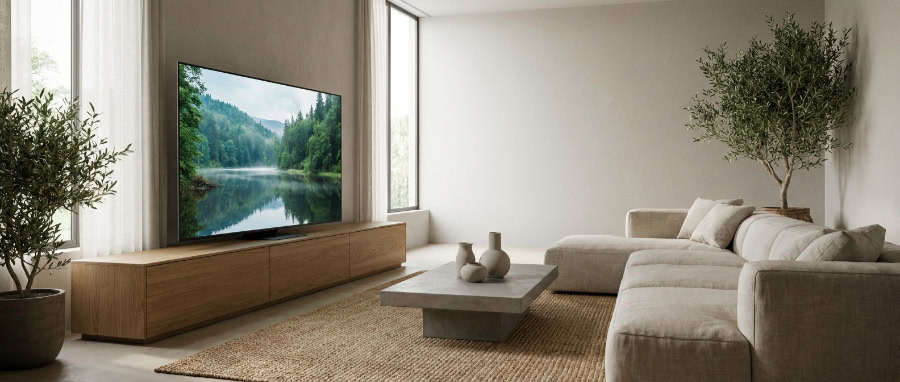
While technical specifications highlight the potential of these displays, the realities of manufacturing dictate their availability to average consumers. Creating high-resolution panels at scale requires sophisticated factory infrastructure and high yield rates.
The divergent manufacturing pathways of these two technologies explain their drastically different positions in the consumer market.
OLED Production Maturity and Yield Rates
OLED technology benefits from over a decade of industrial refinement and massive capital investment. Manufacturing pipelines are highly mature, utilizing established deposition and printing techniques that achieve high yield rates.
This reliability means that factories produce very few defective panels, driving down production costs. Consequently, OLED displays are highly accessible, with prices that allow them to compete directly in the premium and mid-range television markets across a wide variety of sizes.
Micro-LED Assembly Challenges and Mass Transfer Process
In contrast, Micro-LED production faces immense manufacturing hurdles, primarily centered around the mass transfer process. To build a single 4K Micro-LED television, manufacturers must move roughly 25 million microscopic, individual LED chips from their production wafers onto a control backplane.
This transfer must be completed with sub-micrometer precision. Even a minute misalignment or a fraction of a percent of defective chips results in dead pixels, requiring tedious and expensive repair work.
The low yield rates and high defect management challenges associated with this microscopic assembly process remain the primary reasons Micro-LED cannot yet be mass-produced for the general public.
Price-to-Performance Ratio and Size Availability
These manufacturing differences create a vast divide in consumer accessibility. OLED dominates the standard consumer market, offering highly competitive pricing in popular sizes ranging from 42 to 97 inches.
These televisions fit easily on living room walls and media consoles. Micro-LED, however, is restricted to ultra-luxury, modular formats that often start at 100 inches and can scale up to massive walls.
Due to the extreme complexity of their assembly, Micro-LED displays command prices reaching into the tens or hundreds of thousands of dollars, making them exclusive luxury items reserved for custom commercial installations and wealthy enthusiasts.
Distinction from Intermediate Backlight Technologies

As display manufacturers seek to bridge the gap between performance and price, a variety of hybrid technologies have emerged, often creating consumer confusion. It is important to distinguish true pixel-level self-emissive displays from advanced backlighting methods that still rely on traditional liquid crystal panels.
Definition of Mini-LED and Micro RGB Backlights
Many televisions advertised with terms like Mini-LED or Micro RGB are not self-emissive displays. Instead, they are traditional Liquid Crystal Displays (LCDs) that utilize highly advanced backlights.
A Mini-LED TV replaces the large backlight bulbs of older LCDs with thousands of smaller light-emitting diodes grouped into local dimming zones. However, the pixels themselves do not emit light; they merely filter the light coming from behind them.
A true self-emissive Micro-LED display, on the other hand, completely eliminates the liquid crystal layer, as every single subpixel is its own microscopic light source, offering a fundamentally superior architecture.
Contrast and Halo Effect Differences
The difference in backlight architecture has a profound impact on visual purity. Even the most advanced Mini-LED displays, with thousands of local dimming zones, cannot control light at the individual pixel level.
When a bright object, like a white cursor or a subtitle, appears against a dark background, the backlight zone behind it illuminates a larger area than necessary, creating a visible glow or halo effect around the object. Because self-emissive displays like OLED and true Micro-LED control illumination on a pixel-by-pixel basis, they completely avoid this blooming artifact, maintaining perfect contrast boundaries without any light leakage.
Consumer Interpretation of Commercial Jargon
Deciphering retail specifications requires careful attention to the underlying panel technology. Brands frequently use acronyms that closely resemble self-emissive terms to market backlit LCD models.
When evaluating a display, consumers should look past the marketing names and confirm if the panel is truly self-emissive, where each pixel generates its own light, or if it is a backlit LCD variant. Knowing this distinction prevents buyers from overpaying for intermediate backlight improvements when they are seeking the uncompromising contrast of true pixel-level control.
Conclusion
Comparing these two self-emissive systems reveals a clear divide between current market practicality and future engineering potential. OLED remains the premium standard for home theaters, delivering perfect black levels and rich colors at accessible consumer price points.
In contrast, Micro-LED represents the pinnacle of display performance, offering massive brightness levels and complete immunity to image retention, though it remains hindered by extreme assembly costs and production challenges.
Choosing between them depends on your budget and viewing environment. For standard living rooms and dedicated dark rooms, OLED provides an unmatched combination of value, size selection, and cinematic contrast.
If budget is not a constraint and you require an enormous, ultra-bright screen for a highly lit space without any risk of permanent wear, Micro-LED offers a glimpse of the absolute limits of display engineering.
Frequently Asked Questions
Does OLED TV burn-in ever actually happen anymore?
Yes, OLED burn-in can still happen if static images like logos or news tickers are displayed continuously for long periods. Modern televisions use pixel shifting and dimming algorithms to minimize this risk. However, the organic compounds in the screen still degrade unevenly under prolonged static conditions, which can lead to permanent ghost images.
Why are Micro-LED TVs so expensive right now?
Micro-LED displays are extremely expensive because manufacturers must transfer millions of microscopic LED chips onto a backplane with perfect precision. This highly complex transfer process suffers from low yield rates. If even a tiny fraction of the diodes are misaligned, the display has dead pixels, requiring costly and slow manual repairs.
Can I buy a Micro-LED TV for a normal living room?
No, you cannot easily buy a Micro-LED TV for a standard living room because they are primarily sold in massive modular sizes over 100 inches. These displays are tailored for custom luxury installations and commercial spaces. Their physical size, specialized power requirements, and extreme prices make them impractical for average households.
Which screen is better if my room has lots of windows?
Micro-LED is the superior choice for extremely bright rooms because its inorganic semiconductor crystals can output massive levels of light. While OLED televisions deliver beautiful images, they must limit their maximum brightness to prevent permanent screen damage. Micro-LED easily cuts through heavy ambient glare without risking any material degradation.
What is the actual difference between Mini-LED and Micro-LED?
The main difference is that Micro-LED is a self-emissive display where every pixel generates its own light, whereas Mini-LED is just a backlight for a standard LCD screen. Mini-LED TVs still use liquid crystals to block light, which can cause glowing halos around bright objects. True Micro-LED completely avoids this issue.
About the Author: Elizabeth Baker


