
Sony WH-1000XM6 vs. Sony WH-1000XM5: Worth the Upgrade?

Sony’s 1000X headphone series holds a dominant reputation in the wireless audio market, consistently setting the benchmark for active noise cancellation, battery endurance, and travel comfort. With the release of the flagship Sony WH-1000XM6, commuters and audiophiles face a tough choice between the newest hardware and its highly acclaimed predecessor, the WH-1000XM5.
The WH-1000XM6 introduces a faster QN3 processor, refined acoustic tuning, and a returning foldable frame, whereas the older WH-1000XM5 remains widely available at steep retail discounts. Current headphone owners must decide if those generational hardware refinements justify a costly upgrade.
Meanwhile, first-time buyers have to weigh the value of cutting-edge noise suppression and compact portability against the substantial savings offered by proven legacy hardware.
Key Takeaways
- Portability and Case Design: The WH-1000XM6 brings back inward-folding metal hinges and a compact carrying case with a magnetic latch, solving the bulky backpack footprint of the non-folding, zipper-encased WH-1000XM5.
- Faster Noise Cancellation Processing: Equipped with the QN3 processor and 12 microphones, the WH-1000XM6 processes environmental sound seven times faster than the QN1 chip and 8 microphones in the WH-1000XM5, offering superior suppression of sudden mid-to-high frequency noises.
- Refined Audio and Call Clarity: While both models use 1.18-inch drivers, the WH-1000XM6 tightens bass response for clearer midrange vocals and uses expanded beamforming microphones to isolate speech from heavy street wind during calls.
- Battery Endurance Parity and Trade-Offs: Both headphones deliver 30 hours of playback with active noise cancellation enabled and gain 3 hours of listening time from a 3-minute USB Power Delivery charge, though turning noise cancellation off pushes the WH-1000XM5 up to 53 hours compared to 40 hours on the WH-1000XM6.
- Purchasing and Upgrade Strategy: New buyers who travel frequently should invest $449.99 in the WH-1000XM6 for its foldable frame and next-generation connectivity, whereas desk-bound listeners and current WH-1000XM5 owners will find better value in keeping or buying the discounted WH-1000XM5.
Design, Comfort, and Portability
Physical construction and daily ergonomics separate these two generations immediately upon unboxing. While both models maintain Sony’s minimalist aesthetic and matte synthetic finishes, structural changes to the frame, earcups, and storage accessories significantly alter how you pack and wear them.
The Return of the Foldable Hinge Mechanism
The WH-1000XM5 departed from series tradition by utilizing earcups that only swiveled flat, preventing the frame from collapsing into a smaller shape. With the WH-1000XM6, Sony reintroduces reinforced metal inward-foldable hinges that allow the earcups to tuck neatly up toward the headband.
For daily commuters and air travelers, that mechanical redesign makes a major difference in backpack storage. Instead of clearing out a wide, flat compartment to accommodate the rigid frame of the WH-1000XM5, you can fold the WH-1000XM6 into a compact bundle that slips easily alongside a laptop, water bottle, or camera gear.
Headband Structure and Earcup Comfort
Weight remains nearly identical across both generations, with the WH-1000XM5 weighing 8.82 oz (250 g) and the WH-1000XM6 coming in at 8.96 oz (254 g). However, the WH-1000XM5 uses a narrower, rounded headband that can create pressure hotspots on the crown of the head after a few hours.
The WH-1000XM6 addresses crown fatigue with a wider, flatter, asymmetrical headband that distributes weight more evenly across the skull.
Both headphones feature plush synthetic leather earpads with generous internal depth that keeps your ears from rubbing against the internal driver mesh. The WH-1000XM6 adds detachable earpads for easy replacement and uses a slightly gentler clamping force, reducing temple pressure for eyeglass wearers during long listening sessions while maintaining an acoustic seal.
Travel Case Footprint and Magnetic Latch
Because the WH-1000XM5 cannot fold inward, its included carrying case has a wide, bulky footprint that takes up valuable space in carry-on luggage or under an airplane seat. By contrast, the foldable WH-1000XM6 fits into a significantly smaller, more squared-off hardshell case that takes up far less room in a crowded bag.
Sony also replaced the traditional wrap-around zipper found on the WH-1000XM5 case with a quick-access magnetic latch on the WH-1000XM6 case. When you are rushing through an airport security line or stepping onto a train, the magnetic closure lets you open and secure the case with one hand instead of snagging fabric on a zipper track.
Active Noise Cancellation and Processor Power

Active noise cancellation remains the primary selling point of Sony’s flagship lineup, relying on external and internal microphones to analyze and neutralize surrounding sound waves. Generational upgrades in silicon processing speed and microphone count give the newer model a measurable advantage in unpredictable environments.
The QN3 Processor vs. the QN1 Chip
Inside the WH-1000XM5, Sony pairs its HD Noise Cancelling Processor QN1 with an Integrated Processor V1 to manage signals from 8 microphones. The WH-1000XM6 upgrades that internal architecture to the QN3 HD Noise Cancelling Processor, which operates seven times faster than the QN1 chip and coordinates data across 12 microphones.
In everyday terms, a faster processor reads incoming sound waves and generates opposing anti-noise signals with near-zero delay. While the QN1 chip handles steady background hums effortlessly, the high-speed QN3 chip adapts in real time to sudden acoustic spikes, such as a slamming door, a passing siren, or a burst of laughter nearby.
Low-Frequency Engine and Commute Noise Blockage
Both headphones excel at muting constant low-end rumble, including airplane cabin roar, subway track vibrations, and heavy city traffic. Because the WH-1000XM5 already eliminates the vast majority of deep bass frequencies, the improvement on the WH-1000XM6 in low-frequency environments is subtle rather than dramatic.
Where the WH-1000XM6 pulls ahead is in how it manages the sensation of earcup air pressure, often described as cabin pressure feel. Thanks to improved atmospheric pressure optimization and smoother real-time filtering on the QN3 chip, the WH-1000XM6 delivers silence with noticeably less eardrum suction than the WH-1000XM5.
High-Frequency Isolation and Ambient Voice Suppression
Unpredictable mid-to-high frequencies have historically been the hardest sounds for active noise cancellation to erase. Thanks to its 12-microphone array and faster algorithm adjustments, the WH-1000XM6 noticeably outperforms the WH-1000XM5 at dulling office chatter, crying babies, and the sharp clatter of dishes in a busy cafe.
When you need to hear boarding announcements or street traffic without removing your headphones, Ambient Sound mode pipes external audio into the earcups. The WH-1000XM6 produces a cleaner, more natural transparency feed with less background white noise than the slightly digitized pass-through sound of the WH-1000XM5.
Audio Quality and Call Performance
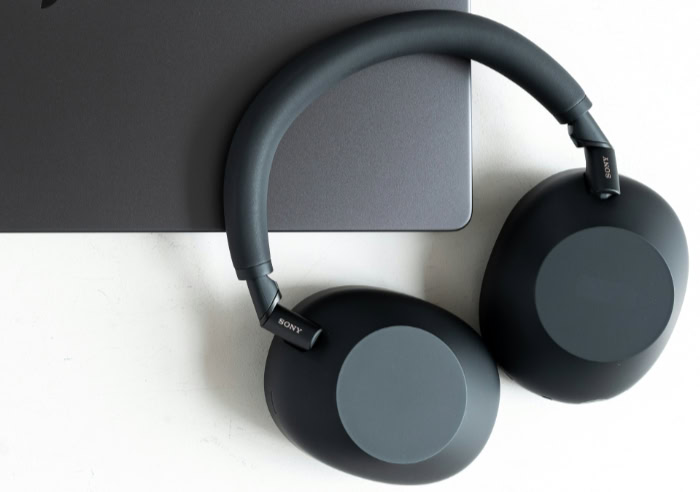
Both the WH-1000XM5 and WH-1000XM6 utilize 1.18-inch carbon fiber composite dome drivers designed to balance light weight with structural rigidity. Despite sharing core driver dimensions, revised acoustic tuning and upgraded voice-pickup hardware create clear distinctions in music playback and voice communication.
Bass Accuracy and Frequency Balance
Out of the box, the WH-1000XM5 delivers a warm, bass-forward sound profile that emphasizes sub-bass thump and lower-midrange punch. While energetic for pop and hip-hop, that heavy low-end tuning can occasionally bleed into the midrange, making acoustic guitars and vocals sound slightly veiled unless you manually adjust the equalizer.
Sony tuned the WH-1000XM6 with a tighter, more controlled low end that preserves deep bass impact without muddying adjacent frequencies. As a result, vocals, snare drums, and piano notes cut through the mix with greater immediate clarity on the WH-1000XM6 before you ever touch any software settings.
Soundstage Depth and Instrument Separation
Closed-back wireless headphones naturally face physical limits in how wide they can project sound across the left and right channels. On the WH-1000XM5, complex orchestral or rock tracks can sometimes feel crowded toward the center of your head during loud passages.
The WH-1000XM6 achieves wider instrument separation and deeper spatial layering, letting you pinpoint individual string and percussion elements across the stereo field. While the cleaner tuning benefits standard compressed music streams via Sony’s DSEE Extreme upscaling engine, the improved separation is especially apparent when playing lossless, high-resolution audio tracks.
Microphone Clarity for Phone Calls and Video Conferences
The WH-1000XM5 earned strong praise for voice pickup during indoor phone calls and computer video chats on platforms like Zoom and Microsoft Teams, using four beamforming microphones and artificial intelligence noise reduction. However, heavy outdoor gusts or loud construction noise can still cause a caller’s voice to sound compressed or robotic on the older model.
By expanding the external microphone network and pairing it with faster neural-network voice isolation, the WH-1000XM6 captures fuller, more natural vocal tone during video conferences. Stepping onto a windy sidewalk or a bustling train platform, the WH-1000XM6 strips away background roar more cleanly, ensuring listeners only hear your speech.
Battery Life, Power Delivery, and Wireless Features

Power efficiency and wireless stability determine how reliably a pair of headphones integrates into a busy daily routine. Both models combine multi-day battery endurance with modern Bluetooth standards and deep software customization.
Total Playback Duration Across Modes
With active noise cancellation turned on, the WH-1000XM6 and WH-1000XM5 are tied at roughly 30 hours of continuous music playback. That endurance easily covers back-to-back international flights or an entire workweek of commuting without needing a wall outlet.
A surprising difference emerges when you turn active noise cancellation off. Because the WH-1000XM5 houses a slightly higher-capacity 1,200 mAh battery compared to the 1,000 mAh cell inside the WH-1000XM6, the older WH-1000XM5 can stretch up to 53 hours with noise cancellation disabled, outlasting the 40-hour maximum rating of the WH-1000XM6.
Rapid Charge Speeds and USB-C Power
When you forget to charge your headphones overnight, both models support rapid charging over USB-C. Connecting either headphone to a compatible USB Power Delivery adapter gives you roughly 3 hours of wireless playback from just a 3-minute charge.
A complete recharge from empty takes approximately 3.5 hours on both units.
For day-to-day convenience, the WH-1000XM6 allows you to listen to Bluetooth audio while charging via USB-C, and both models include a 3.94-foot (1.2-meter) 3.5mm analog audio cable in the box. If the battery is completely depleted mid-flight, you can plug the analog cord directly into an in-flight entertainment system or laptop for passive wired listening, though neither headphone supports digital audio transmission over its USB-C port.
Bluetooth Multipoint, Audio Codecs, and Companion App Controls
Both headphones feature seamless Bluetooth Multipoint connectivity, allowing you to stay paired to two devices simultaneously, such as a work laptop and a personal smartphone. If a call rings on your phone while you are watching a video on your computer, the headphones automatically switch the audio feed to the phone.
While the WH-1000XM5 runs on Bluetooth 5.2 and supports SBC, AAC, and Sony’s high-bitrate LDAC codec, the WH-1000XM6 upgrades to Bluetooth 5.3 and adds native support for the low-energy LC3 codec and Auracast broadcast audio. Inside the Sony Sound Connect companion app, the WH-1000XM6 also upgrades the older 5-band equalizer of the WH-1000XM5 to a granular 10-band equalizer, alongside new real-time spatial audio upmixing and hands-free voice toggles for noise control.
Cost Analysis and Buyer Recommendations

Choosing between two generations of flagship audio gear requires balancing technical improvements against budget constraints. Market pricing shifts the value proposition considerably depending on how you plan to use your headphones every day.
Retail Price vs. Discount Market Value
Sony launched the WH-1000XM6 at a retail price of $449.99, representing a $50 increase over the WH-1000XM5’s original launch price of $399.99. That higher entry cost places the newest model firmly in the ultra-premium price bracket alongside competitors from Bose and Apple.
Furthermore, because the WH-1000XM5 has been on the market longer, it frequently sees retail sales and seasonal price drops that bring its street price down between $279.99 and $329.99. That creates a price gap of $120 to $170 between the two headphones, forcing shoppers to weigh if the newest refinements are worth a substantial premium.
Upgrade Value for Current Sony Headphone Owners
If you already own a working pair of WH-1000XM5 headphones, upgrading to the WH-1000XM6 brings diminishing returns for stationary listening. Unless the non-folding frame, bulky zipper case, or narrower headband of the WH-1000XM5 actively frustrate you during travel, its noise cancellation and audio performance remain close enough to the new model that you can comfortably skip a generation.
Conversely, owners holding onto older models like the WH-1000XM3 or WH-1000XM4 will experience a substantial leap by moving straight to the WH-1000XM6. You get to keep the familiar inward-folding portability of those classic designs while gaining a massive upgrade in microphone call clarity, multi-sensor high-frequency noise suppression, and Bluetooth 5.3 features.
Decision Guide for New Shoppers
The ideal WH-1000XM6 buyer is a frequent flyer, daily transit commuter, or critical listener who values compact portability and top-of-the-line acoustic isolation. If you pack your headphones into a crowded bag every day, take business calls on noisy city streets, and want balanced sound with a 10-band equalizer, the WH-1000XM6 justifies its higher price tag.
On the other hand, the WH-1000XM5 is the smarter purchase for remote workers who leave their headphones on a desk, budget-conscious shoppers, and casual listeners who enjoy extra bass warmth. When portability is secondary, saving over $100 on the WH-1000XM5 gets you 90% of the flagship Sony experience for a fraction of the cost.
Conclusion
Generational updates in the Sony WH-1000XM6 directly address the biggest complaints leveled at its predecessor while pushing active noise cancellation forward. The return of the inward-foldable hinge mechanism and a compact magnetic case restores the travel convenience that commuters missed on the WH-1000XM5.
Paired with the high-speed QN3 processor, a 12-microphone array, and tighter bass tuning, the WH-1000XM6 delivers quieter commutes, clearer phone calls, and a more balanced musical presentation. However, the $449.99 retail price means those refinements come at a steep premium over the heavily discounted WH-1000XM5.
Both models stand as top-tier wireless headphones in today’s audio market; the WH-1000XM6 is the definitive choice for travelers demanding peak performance and compact storage, while the WH-1000XM5 remains an unbeatable value for home, office, and budget-minded listeners.
Frequently Asked Questions
Do the Sony WH-1000XM6 headphones fold up like older models?
Yes, the Sony WH-1000XM6 brings back inward-folding metal hinges that allow the earcups to collapse up into the headband for compact storage. Unlike the WH-1000XM5, which only swivels flat inside a large zippered pouch, the foldable WH-1000XM6 fits into a much smaller travel case equipped with a quick-access magnetic latch.
Is the noise cancellation noticeably better on the Sony WH-1000XM6 than the WH-1000XM5?
The Sony WH-1000XM6 delivers noticeably better noise cancellation against sudden mid-to-high frequency sounds, while low-frequency engine blockage remains similar on both models. Powered by the QN3 processor and 12 microphones, the WH-1000XM6 processes noise seven times faster than the WH-1000XM5, making it far more effective at muting office chatter, crying babies, and cafe clatter.
Why does the Sony WH-1000XM5 have longer battery life than the WH-1000XM6 when noise cancellation is off?
The Sony WH-1000XM5 lasts longer with noise cancellation disabled because it packs a larger 1,200 mAh battery than the 1,000 mAh cell inside the WH-1000XM6. Although both headphones run for 30 hours with noise cancellation active, turning it off extends the WH-1000XM5 to 53 hours versus 40 hours on the WH-1000XM6.
Can you use the Sony WH-1000XM6 and WH-1000XM5 wired if the battery dies?
Yes, both the Sony WH-1000XM6 and WH-1000XM5 work passively as wired headphones when the battery is completely empty by using the included 3.94-foot (1.2-meter) 3.5mm audio cable. However, neither headphone supports digital audio playback through its USB-C port, and powering the headphones on while plugged in provides stronger volume and active equalizer tuning.
Is it worth upgrading from the Sony WH-1000XM5 to the WH-1000XM6?
Upgrading from the Sony WH-1000XM5 to the WH-1000XM6 is only worth the $449.99 price tag if you travel frequently and need a foldable frame with a smaller case. For listeners who primarily wear their headphones at a home desk or office, the WH-1000XM5 already provides comparable battery life and strong low-frequency noise blockage.
About the Author: Elizabeth Baker


