Soundbar vs. TV Speakers: Is an Upgrade Worth It?
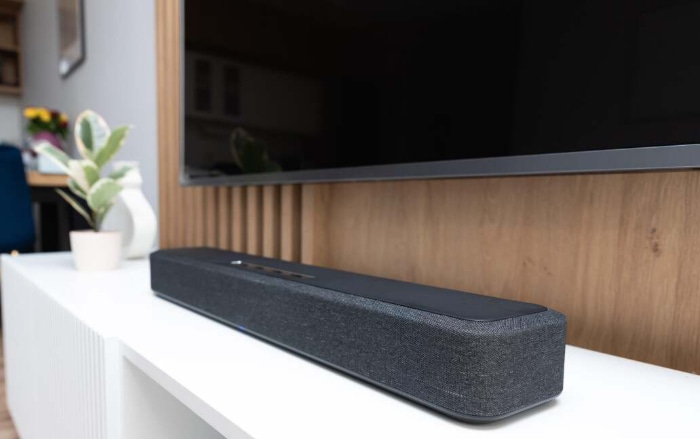
Modern flat-screen televisions deliver stunning, high-definition visuals, but their ultra-thin frames leave minimal interior space for physical audio hardware. As display panels continue to shrink in depth, manufacturers must fit tiny, low-power speakers into cramped plastic enclosures.
This compact design frequently produces weak bass, hollow acoustics, and muffled dialogue. Consequently, many viewers face a familiar dilemma: rely on factory-installed television speakers or invest in a standalone soundbar for a richer home theater experience.
Key Takeaways
- Ultra-thin television chassis restrict speaker cone excursion to less than 0.5 inches and cap shared amplifier output between 10W and 20W, resulting in thin acoustics and chassis rattling at high volumes.
- Standalone soundbars resolve muffled speech by adding a dedicated physical center channel and using equalization processing to isolate dialogue frequencies between 1,000Hz and 3,000Hz.
- While miniature television drivers cut off low frequencies around 150Hz, soundbars paired with external subwoofers reproduce deep sub-bass below 35Hz without muddying the midrange audio.
- Connecting via an HDMI eARC port delivers up to 37 Mbps of bandwidth for uncompressed spatial formats like Dolby Atmos while enabling volume control directly through the standard television remote.
- Integrated speakers provide adequate sound for casual viewing in a compact 10-foot (3.05 m) by 12-foot (3.66 m) bedroom, but expansive living rooms with distant seating between 12 feet (3.66 m) and 15 feet (4.57 m) require a dedicated soundbar.
The Architecture of Built-In TV Speakers and Soundbars
The physical form of modern televisions dictates how sound waves travel through an entertainment room. While flat-panel displays are engineered to be as thin and visually unobtrusive as possible, standalone soundbars prioritize dedicated internal volume to support acoustic reproduction.
These structural differences determine how each audio system moves air, directs sound, and powers its internal components.
Chassis Constraints of Ultra-Thin Televisions
Television depth has decreased significantly, with many contemporary panels measuring less than 1.5 inches deep. Audio production, however, depends on moving physical air.
Speaker drivers need sufficient enclosure depth so their diaphragms can move back and forth along an axis known as excursion. When driver depth and cone excursion are restricted to less than 0.5 inches, the speaker cannot displace enough air to generate full, resonant sound.
Furthermore, the lightweight plastic frames of modern televisions create mechanical resonance problems. As sound waves vibrate inside these thin plastic shells, the chassis itself rattles, introducing buzzing noises and muddying low-end audio frequencies.
Speaker Orientation and Sound Dispersion
Display bezels leave no space on the front panel for audio drivers. Consequently, television manufacturers direct their speakers downward toward the floor or backward toward the wall behind the screen.
Downward-firing drivers rely on sound waves bouncing off tabletop consoles or flooring before traveling toward the listener. Rear-firing drivers must reflect sound off drywall surfaces, which absorb portions of the frequency range depending on paint, wallpaper, and distance.
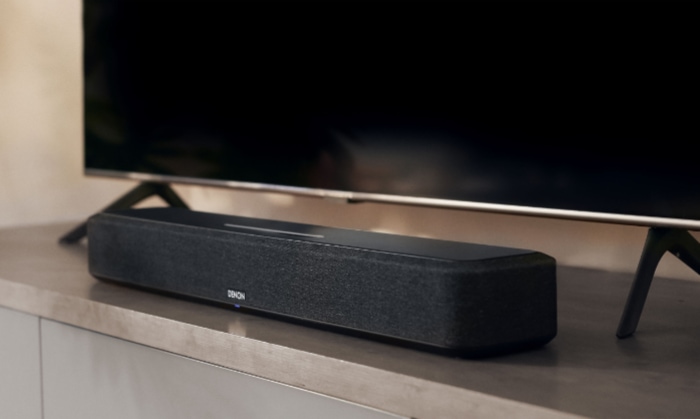
Standalone soundbars place forward-facing drivers across their front grilles, creating direct sound paths that travel straight to listener ears without acoustic reflection losses.
Driver Size and Internal Cabinet Volume
A dedicated soundbar chassis provides generous internal air space that allows speakers to operate efficiently. Inside this larger cabinet, manufacturers isolate specific frequency bands into separate physical chambers, preventing the pressure generated by low-frequency woofers from distorting delicate high-frequency tweeters.
Amplification also differs substantially between both designs. Televisions share power distribution among the display panel, processor, and audio board, typically capping audio power between 10W and 20W across all internal speakers.
Dedicated soundbars incorporate independent power supplies and multi-channel amplifiers rated at 100W, 300W, or higher, ensuring ample current for complex audio reproduction.
Audio Performance and Sound Fidelity
Faithful audio reproduction requires balanced frequency output and clear separation between quiet details and sudden dynamic peaks. The hardware limitations of integrated television speakers contrast sharply with the acoustic capabilities of standalone audio bars across vocal clarity, bass reproduction, and overall volume stability.
Dialogue Intelligibility and Vocal Separation
Modern cinema and television programming mix dialogue, ambient noise, and musical scores across multiple distinct channels. Standard televisions compress these multi-channel audio tracks into basic stereo feeds, forcing spoken words to compete directly with loud sound effects and heavy background music.
Soundbars resolve this congestion by using a dedicated center channel driver dedicated purely to vocal frequencies. Additionally, soundbars use digital signal processing to boost frequencies between 1,000Hz and 3,000Hz, separating speech from background noise so actors remain clear without requiring elevated overall volume.
Frequency Range and Low-End Bass Reproduction
The human ear detects sounds between 20Hz and 20,000Hz, but miniature television drivers rarely reproduce frequencies below 150Hz. This design cuts off the deep frequencies that produce satisfying explosions, rumble, and musical rhythm.
Soundbars use larger drivers paired with bass reflex port tubes and passive radiators, extending their low-end response down toward 50Hz. When paired with an external subwoofer, the system reaches sub-bass frequencies below 35Hz.
Relieving the main soundbar drivers from reproducing deep bass protects the midrange frequencies, allowing instruments and environmental effects to remain crisp and distinct during noisy action scenes.
Volume Thresholds and Distortion Prevention
Integrated television speakers degrade rapidly when pushed to elevated volumes. As the tiny drivers approach their mechanical limits, total harmonic distortion rises, producing audible speaker rattle and harsh treble spikes.
Small television amplifiers lack dynamic headroom, meaning they cannot supply the surge of energy required during sudden cinematic transitions. Soundbars incorporate larger, dedicated amplifiers that maintain clean output even above 80% volume.
Their internal processors also balance equalization, preventing quiet conversations from being drowned out while smoothing harsh spikes during jarring scene changes.
Soundstage Breadth and Surround Formats

The perception of spatial depth in a room depends on physical driver separation and modern multi-channel audio codecs. While television hardware remains locked into standard stereo playback, soundbars provide broader soundstages and pathways to immersive surround formats.
Channel Configurations from Stereo to Multi-Channel Systems
Standard flat-screen displays utilize a 2.0 configuration, consisting of two internal speakers that deliver left and right stereo audio. Soundbars offer more advanced configurations, beginning with 2.1 arrangements that introduce a dedicated subwoofer channel.
Upgrading to a 3.1 system adds an independent center speaker, while 5.1 systems route surround effects to distinct audio channels. The physical width of a soundbar, often spanning 36 inches to 48 inches, places the left and right drivers much farther apart than the compact housing inside a television, spreading the soundstage across the entire width of the seating area.
Virtual Surround Systems and Spatial Audio Support
Televisions use basic software algorithms to simulate three-dimensional audio, but two small downward-firing drivers cannot convincingly create the illusion of rear or overhead effects. Standalone soundbars support advanced spatial audio formats, including Dolby Atmos and DTS:X.
These units feature angled side-firing drivers that bounce sound waves off side walls and upward-firing drivers that reflect audio off the ceiling. This physical reflection technique projects distinct sound cues directly above and behind the listener, mimicking the experience of a commercial theater.
System Expandability with Subwoofers and Rear Satellites
Televisions are closed systems that do not allow users to add supplementary hardware speakers. Soundbars frequently serve as modular platforms that expand alongside user needs.
Many soundbars connect wirelessly to standalone subwoofers that reproduce deep sub-bass frequencies without requiring audio cables across the floor. In addition, users can link two wireless satellite speakers positioned behind the couch, transforming a front-heavy soundbar into a true multi-point surround sound system.
Hardware Setup, Connectivity, and Operation

Integrating external audio equipment into an entertainment center requires selecting the correct cables, configuring control settings, and positioning hardware properly. Modern connection standards simplify this process by transmitting multi-channel digital audio over a single cord while maintaining synchronized remote control operation.
Wired Audio Interfaces and Bandwidth Capacities
Connecting an external sound system involves several interface options. Optical TOSLink connections transmit digital stereo and compressed 5.1 surround sound, but their limited bandwidth cannot carry high-resolution formats.
HDMI ARC (Audio Return Channel) provides higher bandwidth, while HDMI eARC (Enhanced Audio Return Channel) expands data capacity to 37 Mbps, passing uncompressed Dolby Atmos and multi-channel audio streams directly from the screen. Legacy 3.5mm analog auxiliary ports remain compatible with older equipment, though they only transfer basic two-channel stereo without surround metadata.
System Synchronization via HDMI-CEC
HDMI Consumer Electronics Control (HDMI-CEC) links the television and soundbar through the HDMI cable. This communication protocol synchronizes power states, turning the soundbar on and off in unison with the display panel.
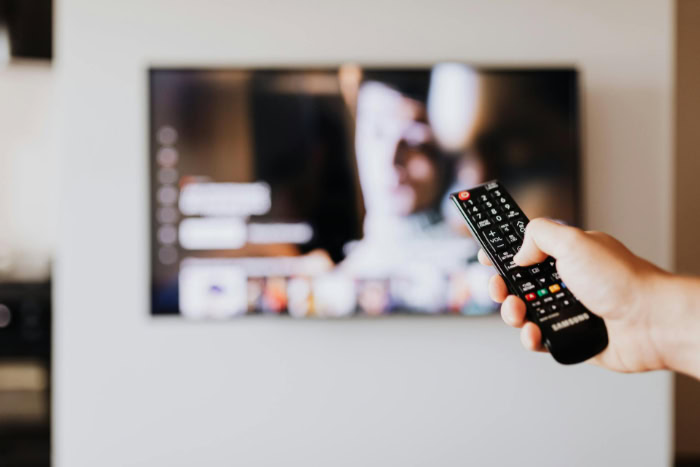
It also enables the standard television remote control to alter soundbar volume and mute functions, eliminating the need to manage multiple remotes. Furthermore, HDMI-CEC assists with audio latency reduction, correcting lip-sync discrepancies that occur when advanced video processing delays visual frames relative to the audio track.
Physical Placement, Space Demands, and Cable Organization
A soundbar placed on a media console must have adequate clearance beneath the display. If the soundbar sits too high, it can obstruct the lower bezel of the television, blocking the infrared (IR) sensor from receiving remote commands.
Wall-mounted installations use dedicated steel brackets fixed directly into wall studs beneath the display. Power outlets must remain accessible for both the soundbar and any associated subwoofers, while single HDMI connections allow owners to route wires cleanly through wall cavities or surface raceways to maintain an orderly entertainment area.
Consumer Selection Criteria and Use Scenarios
Deciding between factory television speakers and an external soundbar requires evaluating room dimensions, acoustic properties, and financial considerations. Matching equipment to specific listening habits ensures satisfactory audio quality without unnecessary expense.
Room Scale and Acoustic Environment
In small bedrooms measuring 10 feet (3.05 m) by 12 feet (3.66 m), built-in television speakers often produce sufficient volume for casual viewing. In contrast, large open-concept living rooms and areas with 10-foot (3.05 m) ceilings disperse downward-firing television audio before it reaches the listener.
Distant seating arrangements located 12 feet (3.66 m) to 15 feet (4.57 m) away require the direct acoustic projection and higher output of a soundbar to preserve clarity across the entire seating zone.
Media Consumption Profiles
Content selection dictates the audio demands placed on playback hardware. Viewers who primarily watch news broadcasts, game shows, and talk shows require vocal clarity that basic television speakers can often provide.
Cinematic movies, modern video games, and orchestral music demand wide dynamic ranges, deep bass impact, and subtle spatial effects that only multi-driver soundbars can deliver. Soundbars also benefit late-night viewers through night listening modes that compress audio dynamics, keeping dialogue intelligible while softening loud sound effects.
Price Tiers and Cost-to-Performance Ratios
Factory television speakers require zero financial investment and consume no additional living room space. Entry-level soundbars priced between $80 and $150 provide an immediate boost in dialogue separation and volume stability over built-in audio.
Mid-range systems priced between $200 and $500 introduce wireless subwoofers, center dialogue channels, and basic spatial processing. Premium soundbars ranging from $800 to $1,500 compete directly with traditional AV receiver systems, providing high-fidelity spatial audio without the aesthetic clutter of standalone amplifiers and extensive speaker cabling.
Conclusion
Integrated television speakers provide a functional, zero-cost baseline that keeps entertainment consoles uncluttered, but physical chassis constraints limit their vocal clarity, bass depth, and overall dynamic range. Standalone soundbars resolve these hardware bottlenecks by positioning dedicated, forward-firing drivers and isolated acoustic chambers directly in front of the listener.
While adding a soundbar requires an upfront purchase between $80 and $1,500 along with surface space beneath the display, the return in speech intelligibility and cinematic immersion is substantial. Choosing the ideal audio configuration rests on matching the hardware to the listening environment.
Small bedrooms and dialogue-focused broadcasts function well on standard television hardware, while open-concept living rooms, cinematic movies, and modern video games justify the physical space and financial investment of a dedicated soundbar system.
Frequently Asked Questions
Do I really need a soundbar if my TV is in a small bedroom?
You usually do not need a soundbar for a small bedroom because built-in television speakers can easily fill compact spaces with adequate volume. However, if you frequently struggle to understand muffled dialogue at lower volumes, an entry-level soundbar with vocal enhancement makes speech much clearer without disturbing people in adjacent rooms.
Will a soundbar work with my existing TV remote?
Yes, a soundbar will work with your existing television remote if you connect both devices through an HDMI ARC or HDMI eARC port. This setup uses HDMI Consumer Electronics Control to synchronize power and volume commands. Connecting through an optical cable, however, requires a separate remote to manage audio levels.
Why is dialogue so hard to hear on modern flat-screen TVs?
Dialogue sounds muffled on flat-screen televisions because downward-firing speakers force human voices to compete with background effects inside a basic stereo mix. Without a dedicated center speaker channel for speech, multi-channel soundtracks blend vocals into loud action scenes. Tiny speakers in thin plastic frames also fail to project clear mid-range vocal frequencies forward.
What is the difference between an optical cable and HDMI ARC?
The main difference is that HDMI ARC supports higher data bandwidth and unified remote operation, while optical cables only transmit compressed digital audio. Optical connections max out at basic 5.1 surround sound and lack Dolby Atmos support. HDMI ARC and eARC connections deliver uncompressed multi-channel sound while synchronizing power and volume controls across devices.
Can a soundbar create true surround sound without extra rear speakers?
No, a standalone soundbar cannot produce true surround sound without physical rear speakers, though it can simulate directional audio effectively. Advanced soundbars bounce sound off side walls and ceilings using angled drivers, creating convincing virtual height. Even so, physical rear satellites are required to experience distinct sound effects originating directly behind your seat.
About the Author: Elizabeth Baker