
What Is Surround Sound? How It Works

Modern flat-panel televisions deliver impressive visual clarity, but ultra-thin profiles leave virtually no physical depth for capable built-in speakers. As a result, dialogue frequently sounds muffled and action sequences lack dynamic weight, prompting many viewers to transition toward dedicated home audio systems.
Multi-channel surround sound solves common audio deficiencies by distributing distinct sound elements across multiple physical or virtual speakers positioned around a room. Successful adoption requires knowing standard system labels, selecting compatible processing hardware, and positioning equipment to account for natural room reflections.
Effective configuration ultimately transforms standard living spaces, elevating everyday movies, streaming series, and interactive video games into deeply immersive acoustic environments.
Key Takeaways
- Multi-channel audio separates sound into distinct channels, where the first digit represents full-range speakers and the second digit denotes low-frequency subwoofers (such as 2.1, 5.1, or 7.1).
- A dedicated center channel speaker anchors dialogue directly to the screen, preventing spoken words from being drowned out by background music or loud effects.
- Object-based audio formats like Dolby Atmos and DTS:X use a third digit (such as 5.1.2) to add overhead height channels, producing a three-dimensional acoustic dome around the listener.
- HDMI eARC provides up to 37 Mbps of bandwidth to transmit uncompressed audio codecs, whereas legacy optical cables are restricted to compressed 5.1 or two-channel stereo signals.
- Automated room calibration software uses a setup microphone to measure room reflections and speaker distances, applying digital equalization filters to balance sound output across all channels.
Definition and Core Principles of Surround Sound
Sound plays a fundamental role in how audiences perceive physical space, drama, and action within media. Unlike conventional playback systems that present sound from a fixed frontal position, surround sound creates an expansive environment by projecting distinct audio streams around the listener.
Examining how multiple audio tracks interact with human hearing reveals how modern audio engineering creates convincing acoustic depth and spatial immersion.
The Concept of Multi-Channel Audio
Multi-channel audio relies on an architecture that divides a single sound recording into multiple independent audio tracks, known as channels. Instead of mixing dialogue, musical scores, and sound effects into a single unified output, sound engineers route specific sounds to designated speakers arranged throughout the listening space.
This architecture stands in stark contrast to single-point sound sources, which broadcast audio from one central location. A single speaker forces all auditory information into an isolated origin point, flattening spatial cues and compressing acoustic depth.
Multi-channel audio spreads these elements into a 360-degree soundstage, simulating the natural acoustic behavior of physical environments where sounds arrive from every direction.
Contrast Between Mono, Stereo, and Surround Sound
Monophonic audio, commonly called mono, uses a single audio channel reproduced through one or more speakers. Every speaker in a mono setup plays the exact same signal, meaning there is no sense of lateral movement or physical width.
Stereophonic audio, or stereo, introduces two distinct channels, designated as left and right. Stereo playback creates a two-dimensional stage in front of the listener, allowing sounds to pan horizontally across the front field.
While stereo works well for standard musical recordings, it carries significant limitations for cinematic media and modern video games. A two-channel presentation cannot reproduce sounds occurring behind, beside, or directly above the listener.
When an on-screen vehicle drives past the camera and moves into the distance behind the audience, stereo audio can only fade the volume down in front, failing to deliver the physical sensation of movement through space.
Directional Sound and Human Acoustic Perception
Human auditory perception determines the location of sounds through physiological and acoustic cues. The brain calculates the horizontal position of a sound source by analyzing the interaural time difference, which is the tiny delay between a sound wave reaching the nearer ear compared to the further ear.
In addition, the head and outer ears create an interaural level difference, altering the volume and frequency balance of sounds depending on their direction.
Elevation and rear positioning are decoded through subtle frequency filtering caused by the shape of the outer ear, known as the pinna. Multi-channel audio systems leverage these biological processing mechanics by sending carefully timed and calibrated audio cues from precise physical angles.
When sound engineers manipulate these signals, the brain receives the necessary spatial data to identify exact distances and trajectories, rendering media scenes far more convincing.
Channel Layouts and System Designations

Home theater configurations use standardized numerical designations to define their speaker arrangements. These labels tell consumers exactly how many full-range speakers, subwoofers, and overhead channels make up a system, establishing clear expectations for hardware layout and acoustic performance.
Overview of Standard Channel Labels (2.1, 5.1, and 7.1)
Audio system labels use a decimal structure to describe speaker counts. The first digit represents the number of full-range or satellite speakers handling middle and high frequencies.
The second digit, following the decimal point, indicates the quantity of dedicated low-frequency subwoofers.
A 2.1 setup serves as the entry-level configuration, utilizing two front stereo speakers and one subwoofer to bolster low-end bass. Moving upward, a 5.1 setup represents the traditional benchmark for home theater.
It incorporates five full-range speakers, consisting of three front channels and two surround channels, coupled with one subwoofer. An expanded 7.1 configuration adds two rear surround speakers behind the seating area, totaling seven full-range speakers and one subwoofer to fill larger rooms with seamless front-to-back transitions.
Specific Roles of Center, Surround, and Subwoofer Speakers
Each speaker in a multi-channel configuration serves a dedicated acoustic purpose. The center channel speaker sits directly below or above the display, functioning as the anchor for dialogue, spoken narration, and centered on-screen action.
By isolating voices to a dedicated speaker, the system prevents dialogue from being drowned out by background music or heavy effects.
The left and right front speakers handle musical scores and directional effects that occur across the screen, while the surround satellite speakers generate ambient atmosphere, such as falling rain or room reverberation, alongside off-screen sound effects. The subwoofer reproduces Low-Frequency Effects (LFE), handling deep bass notes, rumble, and concussive impacts typically filtered below 80Hz.
Because low-frequency sound waves are largely non-directional to human ears, a single subwoofer can effectively distribute bass throughout an entire room.
Object-Based Sound and Height Channels (Dolby Atmos and DTS:X)
Modern home entertainment has shifted toward object-based spatial audio formats, led by Dolby Atmos and DTS:X. In conventional channel-based audio, sounds are mixed directly to static speaker outputs, such as the left surround or center channel.
Object-based audio treats individual sounds as independent entities with assigned three-dimensional coordinates, allowing the playback processor to calculate how that object moves across available speakers in real time.
To support three-dimensional positioning, modern setups introduce a third digit to their naming conventions, such as 5.1.2 or 7.1.4. The third digit specifies the number of height channels, which use ceiling-mounted or upward-firing speakers that reflect sound off the ceiling.
By introducing vertical sound placement, overhead audio transforms a flat, horizontal soundstage into a three-dimensional hemispheric dome around the audience.
System Architecture and Reproduction Methods
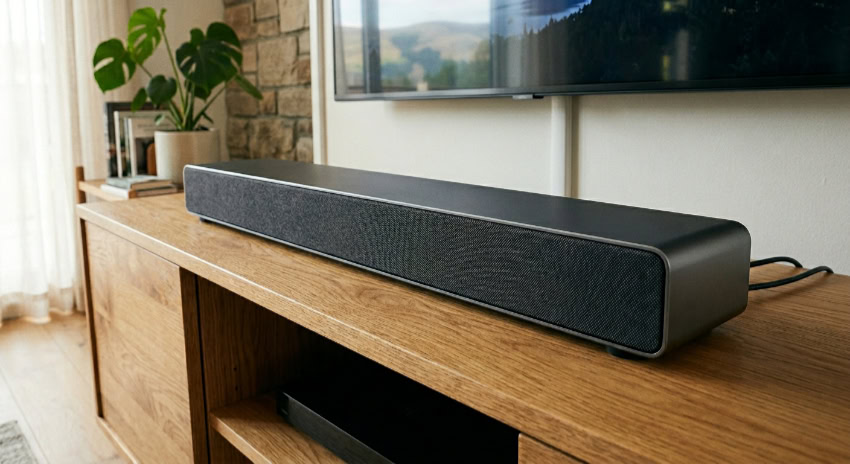
Delivering multi-channel sound into a living environment can be accomplished through several distinct hardware approaches. Depending on room constraints, budget, and aesthetic preferences, listeners can choose between physical speaker arrays, algorithmic soundbars, or personal audio devices.
True Multi-Speaker Hardware Deployments
True multi-speaker deployments rely on individual, physical speakers placed at designated positions throughout the room. Each speaker connects directly to an amplification source and handles an isolated channel or spatial object.
Physical setups offer the highest level of acoustic precision and channel separation. Because physical speakers occupy the actual acoustic locations where sounds originate, they generate authentic directional cues without relying on acoustic trickery.
Sound travels directly from the driver to the listener, minimizing phase cancellation and maintaining dynamic impact across broad seating areas.
Virtual Surround Algorithms in Soundbars
For rooms where running multiple speaker cables is impractical, soundbars use digital signal processors (DSP) and psychoacoustic modeling to simulate an expansive sound field from an all-in-one unit. These algorithms manipulate the phase, timing, and equalization of audio signals to trick the human brain into perceiving sound sources beside or behind the listener.
Many modern soundbars supplement digital signal processing with physical, angled side-firing and upward-firing drivers. These drivers project sound waves toward side walls and ceilings, bouncing the sound toward the listener.
While effective in symmetrical rooms with flat, solid walls, virtual surround systems can struggle in open-concept floor plans where sound reflections scatter unevenly.
Spatial Sound for Headphone Use
Spatial sound for headphones brings multi-channel and object-based experiences to personal listening devices. This technology utilizes software-based binaural processing, which applies Head-Related Transfer Functions (HRTF) to standard stereo drivers.
HRTF algorithms filter incoming multi-channel audio by simulating how sound waves interact with human head anatomy, torso reflections, and ear geometry.
Personal spatial sound has become especially prominent in computer gaming and mobile entertainment. In competitive games, accurate spatial rendering allows players to pinpoint enemy footsteps and environmental cues instantly through a standard pair of stereo headphones, delivering immersion without requiring dedicated room hardware.
Hardware Components and Connection Protocols

Creating a functional surround sound environment requires coordinating dedicated hardware components and appropriate digital connection standards. Ensuring each piece of the playback chain communicates properly guarantees uncompressed signal transfer and stable decoding.
Audio-Video Receivers and Amplification Units
An Audio-Video Receiver (AVR) functions as the central management hub in a traditional component system. It performs three primary duties: switching between multiple input sources, decoding complex multi-channel audio signals, and amplifying low-level audio signals into high-power currents that drive passive speakers.
Passive speakers contain no internal power supplies and rely entirely on an external AVR or dedicated amplifier for power. In contrast, active or powered speakers feature built-in amplifiers inside their cabinets.
Many soundbars and wireless surround systems use active designs, which eliminate the need for an external receiver box by housing all amplification and processing components internally.
Digital Transmission Standards (HDMI eARC, Optical, and Wireless)
Transmitting multi-channel audio requires sufficient digital bandwidth between source devices, displays, and audio processors. Traditional optical connections, known as TOSLINK, rely on fiber-optic cables developed in the 1980s.
Optical cables lack the bandwidth necessary for uncompressed multi-channel audio, limiting playback to legacy compressed 5.1 formats like standard Dolby Digital or two-channel uncompressed stereo.
HDMI eARC (enhanced Audio Return Channel) provides a substantial bandwidth increase, supporting transfer rates up to 37 Mbps over high-speed HDMI cables. This allows HDMI eARC to transmit uncompressed formats, including Dolby TrueHD, DTS-HD Master Audio, and multi-channel uncompressed LPCM alongside object-based metadata.
For wire-free installations, wireless transmission standards like WiSA (Wireless Speaker and Audio Association) operate over dedicated 5 GHz radio frequencies, transmitting uncompressed 24-bit audio at 48kHz or 96kHz with negligible latency under 5 milliseconds.
Playback Devices and Content Compatibility
A surround sound system can only output multi-channel audio if the source hardware and media supply the correct data. Modern playback devices such as streaming boxes, gaming consoles like the PlayStation 5, and 4K Ultra HD Blu-ray players must be configured to output bitstream audio or multi-channel LPCM over their digital connections.
Content compatibility also dictates performance. Streaming services deliver audio encoded in compressed formats like Dolby Digital Plus, which can carry Atmos metadata, whereas physical Blu-ray discs offer lossless, high-bitrate codecs such as Dolby TrueHD and DTS-HD Master Audio.
If the source material only contains a two-channel stereo track, the playback processor must use upmixing modes to distribute sound across multiple speakers.
Implementation Challenges and Corrective Solutions

Installing a surround sound system often presents practical obstacles related to room geometry, interior aesthetics, and acoustic reflections. Applying proper placement guidelines and system tools ensures optimal performance within typical residential spaces.
Room Boundary Reflections and Speaker Placement
Untreated domestic rooms frequently create acoustic distortions. Hard boundaries, such as bare drywall, hardwood floors, and large glass windows, cause excessive sound reflections and flutter echoes that muddy dialogue clarity.
In addition, asymmetric room layouts can cause uneven bass accumulation, leading to boomy or hollow low frequencies.
Optimizing speaker placement minimizes these boundary issues. Front left and right speakers should sit equidistant from the primary listening position, angled between 22 and 30 degrees toward the listener.
High-frequency tweeters should align closely with seated ear level, typically around 38 inches to 42 inches from the floor. Surround speakers in a 5.1 setup should sit slightly behind the listener at angles between 110 and 120 degrees, positioned about 1 foot (0.30 meters) to 2 feet (0.61 meters) above seated ear level to produce a diffuse ambient soundstage.
Cable Management and Modern Wireless Alternatives
Running copper speaker wires across a living room poses both functional and aesthetic challenges. Common solutions for physical cable management include routing wires inside paintable surface raceways along baseboards, tucking thin cables beneath carpet edges, or fishing wiring through interior wall cavities for a completely hidden finish.
For rooms where running cables is structurally unfeasible, wireless home theater ecosystems offer a viable alternative. These platforms connect satellite surround speakers and subwoofers via proprietary low-latency wireless transmitters.
While these speakers still require connection to standard electrical wall outlets for power, they eliminate the need to run signal cables across the room.
Automated Room Calibration and Dialogue Clarity Enhancement
Modern audio receivers and premium soundbars include automated room calibration software to compensate for acoustic irregularities. Systems like Audyssey, Dirac Live, and YPAO use an included calibration microphone placed at the listening position to measure frequency responses, boundary reflections, and speaker distances.
The software then applies corrective digital equalization filters and timing adjustments to balance sound output across all channels.
To address dialogue intelligibility without increasing overall volume, systems feature built-in dialogue enhancement modes that boost the specific frequency range of human speech. In addition, dynamic range compression settings, often labeled as night mode, reduce the volume difference between quiet spoken lines and loud sound effects, preventing sudden volume spikes during late-night listening.
Conclusion
Multi-channel and object-based audio transform ordinary viewing by replacing flat sound with an expansive, three-dimensional acoustic environment. Distributing specific audio cues across distinct physical or virtual channels restores directional realism, stabilizes dialogue clarity, and adds physical depth to low-frequency effects.
Choosing the right setup depends on balancing room boundaries, budget, and wiring preferences. While compact virtual soundbars offer convenient spatial simulation for smaller spaces or open-concept living rooms, full discrete speaker layouts deliver unmatched acoustic separation and precision for dedicated home theaters.
Evaluating room dimensions and personal listening habits ensures an audio configuration that brings movies, gaming, and music to life with authentic realism.
Frequently Asked Questions
What is the difference between 5.1 and 7.1 surround sound?
A 7.1 system adds two rear surround speakers behind your seating position to standard 5.1 audio. While a 5.1 setup uses five full-range speakers and one subwoofer to cover front and side audio, 7.1 introduces dedicated rear channels. This extra pair creates seamless front-to-back transitions, which is especially noticeable in larger rooms.
Can I get true surround sound from just a soundbar?
No, a single soundbar provides virtual surround sound rather than true physical surround sound. Soundbars rely on digital processing and angled drivers that bounce sound waves off your walls to simulate surround effects. While this creates a wide listening field, physical satellite speakers placed around the room still offer superior precision and channel separation.
Do I need an HDMI eARC port to get Dolby Atmos?
Yes, you need an HDMI eARC connection if you want lossless, uncompressed Dolby Atmos audio. Older HDMI ARC and optical ports lack the bandwidth for high-bitrate TrueHD streams found on Blu-ray discs. However, standard HDMI ARC can still pass compressed Dolby Atmos delivered through streaming services that use Dolby Digital Plus.
Where should I place a subwoofer in my living room?
Placing a subwoofer along the front wall near a corner generally delivers the strongest bass response. Because low-frequency bass waves are non-directional, placement is flexible, but corner boundaries amplify low frequencies naturally. You can perform a subwoofer crawl by placing the sub at your seat and listening from different room spots to find the cleanest bass.
Why is movie dialogue so quiet compared to sound effects?
Movie soundtracks feature wide dynamic range, which keeps speaking voices at realistic volumes while explosions and action scenes sound much louder. If your room lacks a dedicated center channel speaker, voices can easily be muffled. Enabling your receiver’s dialogue enhancement or dynamic range compression mode balances these levels for easier listening at moderate volumes.
About the Author: Elizabeth Baker


